
With Premier David Eby calling a provincial election, British Columbia is entering a campaign shaped by a political landscape that is more competitive than the turmoil surrounding the BC Conservatives might suggest.
These are the results of an online survey conducted between August 24, 2026, and August 25, 2026, sponsored and conducted by INNOVATIVE RESEARCH GROUP. This survey interviewed n=2,818 Canadian citizens aged 18 or older. The results are nationally weighted to n=1,500 and for BC to n=500. Results are weighted by age, gender, region, education, and self-reported past federal vote to ensure the overall sample’s composition reflects the population, according to Census data.
The Conservatives are once again facing a leadership transition after Kerry-Lynne Findlay’s resignation after only a few months in the role. The party must now choose another leader and may have to contest the election without a permanent successor.
Yet new research from INNOVATIVE Research Group finds the BC NDP leading the Conservatives by only four points, 43% to 39%. Since August, NDP support has moved up marginally while Conservative support has fallen four points. Despite the Conservatives’ leadership crisis, the governing party has not opened a decisive lead.
Despite a fairly tight margin, the NDP’s broader position has improved since August. Government satisfaction is up since August, with British Columbians now evenly divided, 47% satisfied and 47% dissatisfied. David Eby also holds the strongest personal rating among the party leaders, with 40% viewing him favourably and a net favourability score of +6.
Part of that improvement appears to reflect a shift in what people are hearing about provincial politics. As attention has shifted to Donald Trump and the provincial government’s response to developments south of the border, the NDP has benefited from generally positive public reaction. Among those who have heard about the government’s response, 40% say it has left them with a more favourable impression, compared with 19% who say the opposite. Just over half (52%) approve of the government’s response to Trump.
However, the electorate is not fully embracing the status quo. A clear majority, 57%, still believes it is time for a change in government. Prior to the focus on Trump, the public debate was far more negative toward the NDP, and time for a change shows the public remembers.
There are three big issues as we look ahead.
First, will Donald Trump remain front and centre, or will other issues and stories grab the spotlight?
Second, will there be a backlash to a pretty cynical election call? Typically, voters shrug off acts of political opportunism. But the David Peterson defeat reminds us it is not a given.
Third, will the BC Conservatives be able to revive their image as a potential government, or will the next version reveal a less than competent Game of Thrones?
Fourth, will there be a vote-splitting alternative on the center right? A number of people have been working hard to establish a pragmatic, centrist alternative. Will they just fold up their tent and rejoin the Conservatives?
That is where the possibility of a new centrist party becomes important.
Some political space exists between the NDP and the Conservatives, but the evidence does not point to a large, ready-made centrist constituency. Thirty-one per cent of British Columbians reject both major parties, yet only 17% say they would definitely or be very likely to vote for a new, pragmatic centrist party.
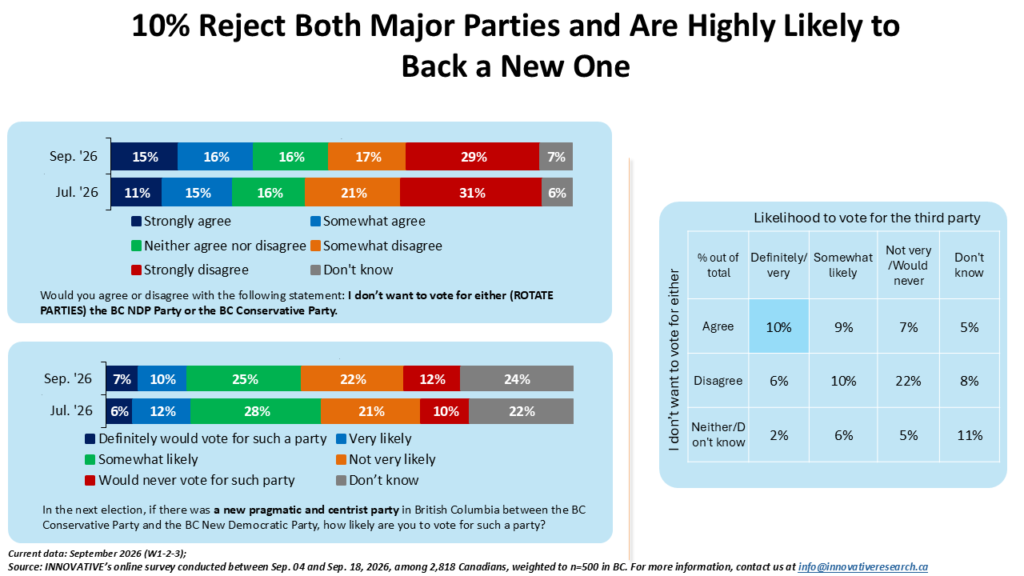
More importantly, potential centrist support does not appear to be drawn evenly from both sides. A new party would be more likely to attract voters currently aligned with the BC Conservatives or smaller parties than voters supporting the NDP.
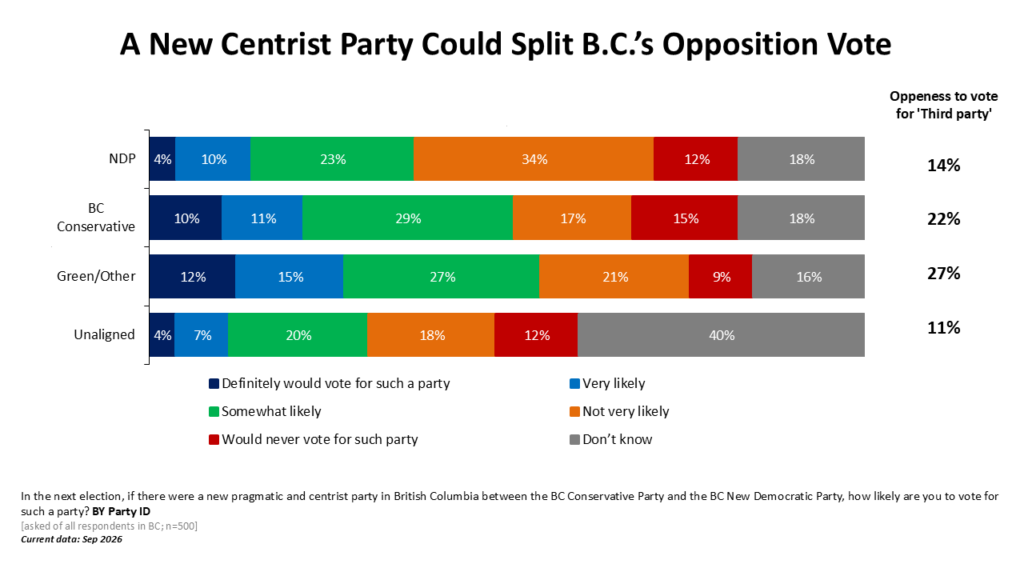
The findings point to a paradox at the heart of the campaign. Many British Columbians want change, and a significant minority are dissatisfied with both leading choices. But unless a centrist alternative can rapidly build broad support, its most immediate effect may not be to win seats or replace the Conservatives. Instead, it may make the NDP’s path to re-election easier.