
As the federal government advances private investment in Canada’s largest airports, public opinion is divided over whether the proposal represents getting things done or putting corporate interests first.
Innovative Research Group Inc. (INNOVATIVE) conducted and sponsored the online survey among a sample of 3,562 Canadian citizens (weighted to a sample size of 1,500). The survey was in field from October 15–November 2, 2026.
In INNOVATIVE Research Group’s pre-budget Canada This Month survey, the public split on the idea of airport privatization. 41% said that the airport proposal shows the Carney government looking for new ways to get things done. Almost as many (38%) see it as putting corporate agendas ahead of the public interest. Twenty per cent are unsure.
That divide provides a timely backdrop to the federal budget released November 5. Budget 2026 advances long-term operating concessions at the four largest airports, while retaining public ownership of the land and assets. It also proposes oversight and rules against unreasonable airport-fee increases. We are in the field now to test these budget details, so bear in mind that this data is from the pre-budget discussion.
General openness to P3s does not guarantee airport support
38% support increasing private-sector involvement in government services generally. Support for the airport proposal is lower, at 31%, while opposition is higher: 25%, compared with 18% for private-sector involvement generally.
Crossing the two questions makes the distinction clearer. 22% support both approaches, but 16% support private-sector involvement generally without supporting the airport proposal. A smaller group, 9%, support the airport proposal without supporting the broader idea.
A further 25% oppose at least one approach and support neither, while 28% are neutral or unsure about both.
Different views of government intent accompany different policy positions
Among those who support both approaches, 76% see the airport proposal as the government finding new ways to get things done. Among the opposition-inclined group, 70% see corporate agendas taking priority.
The P3-specific supporters are more divided: 38% select the “getting things done” interpretation, 42% select “corporate agendas,” and 20% are unsure. Their responses show why general openness to private-sector involvement should not be assumed to extend to airports.
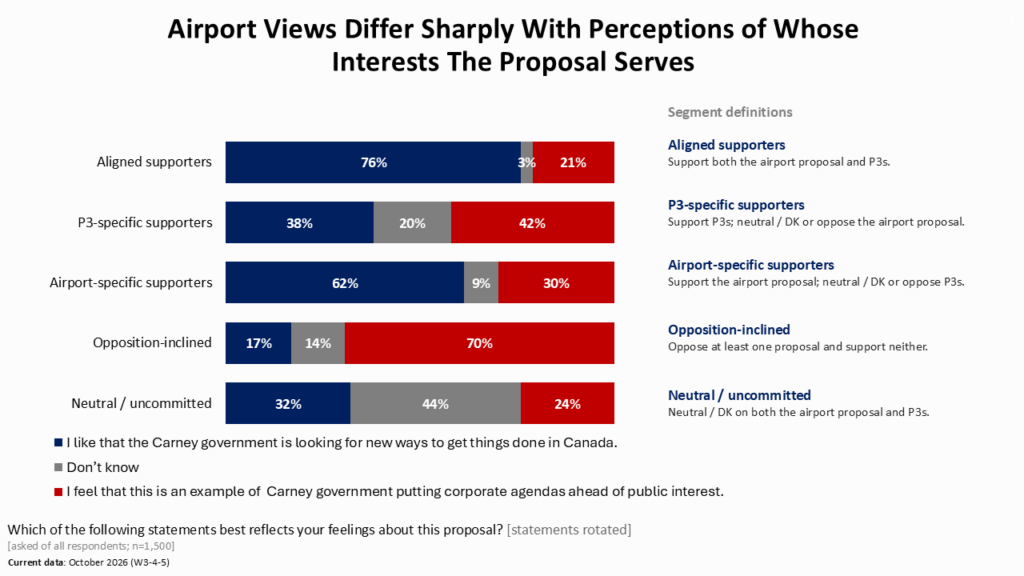
These are associations, rather than proof of what causes support or opposition. Nonetheless, they show that views of the proposal are closely connected with perceptions of the government’s intentions.
A substantial share has yet to take a side
Overall, 31% support the airport proposal, 25% oppose it, and 44% are neutral or unsure. Although 62% have at least heard of the announcement, only 39% describe themselves as familiar with it.
As the government develops the concession framework outlined in Budget 2026, the public debate will involve more than the availability of private capital. The findings suggest that explaining how the arrangement serves travellers and protects the public interest will be central to the discussion – whether the new budget succeeds in addressing those concerns will define how public opinion develops. We will be watching as the debate unfolds with further research.