
Smith and her government see their favourables decline among Conservative voters, with losses among both the separatist and federalist wings of the UCP.
These are the results of an online survey conducted between September 4th, 2026, and September 18th, 2026, sponsored and conducted by INNOVATIVE RESEARCH GROUP. This survey interviewed n=543 Albertans aged 18 or older. The results are provincially weighted to n=500. Results are weighted by age, gender, region, education, and self-reported past federal vote to ensure the overall sample’s composition reflects the population, according to Census data.
It has been a lively ten days in Alberta politics since Danielle Smith’s United Conservative Party lost the Calgary-Shaw by-election. In the aftermath of losing a south Calgary stronghold riding for the party in the last two elections, and with the October 19th referendum vote coming up fast, how are Albertans responding to the vote, and to the Premier? Janet Brown has ballot numbers out today for CBC showing a dead heat between the UCP and NDP. While that is a closer race than we see, there is no doubt the UCP is facing growing problems.
Let’s zoom in and look at those identifying as UCP voters, and their responses to the Premier and her government. Smith has spent the last year of her Premiership navigating the tension between federalists and separatists within the UCP coalition. If she could retain support from both wings of the party, then maintaining the UCP’s lead over the NDP would be greatly eased. So too would pressure on her leadership position.
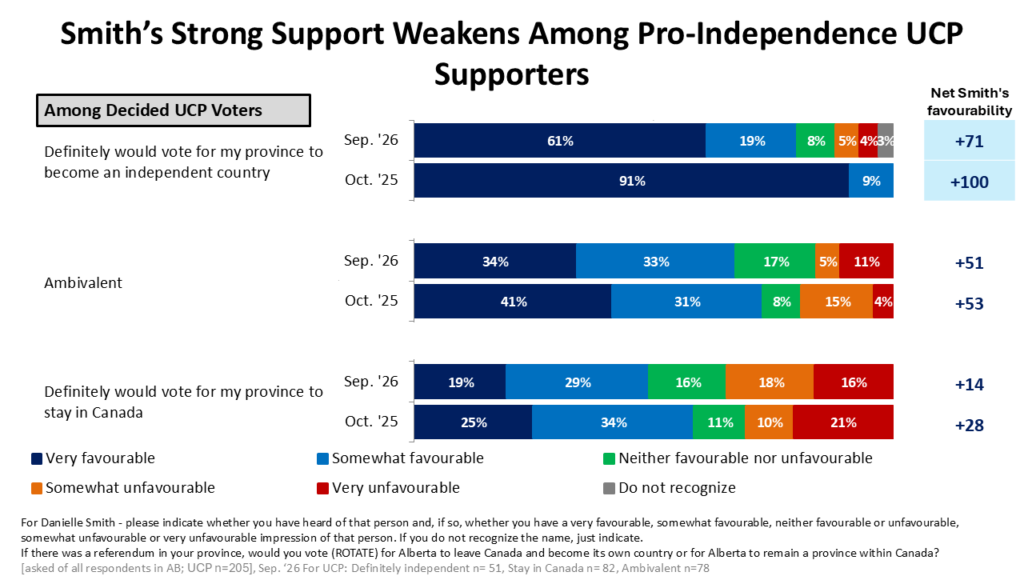
Over the last eleven months, we can see that Smith’s favourability within all factions of the party has faded. If we look only at decided UCP voters, there is a clear decline in Smith’s personal image. Among the party’s separatist faction, her net favourable has declined by 29 points, from effective unity to +71. This is a notable decline in a group that was an important part of Smith’s internal coalition. Among those who would definitely vote to stay in Canada, Smith’s net favourable has declined from +28 to +14.
If we zoom out and look at the wider Alberta electorate, we see that views of both Smith and the Alberta government are more negative than positive. Smith’s net favourability among the entire electorate has trended downward since April (when it was +5) to -11, while a majority (54%) now reports being dissatisfied with the provincial government as opposed to 40% satisfied.
Perhaps most troubling for the government, when people hear news about the Premier, it is more likely to hurt than to help her image. A narrow majority of Albertans (53%) report hearing something about the Premier in the last few days. Among those who recall hearing about her, 52% say it made them less favourable, compared to 23% who said it made them more favourable. The top three issues recalled are Separatism and provincial autonomy (18%), U.S. tariffs and trade (16%), and the October referendum (16%), all with a negative impact on her favourability (net impact scores respectively -15, -17, -24).
This decline in the approval of the Premier and her government is not tied to any change in the referendum question on moving forward with an independence process. Support for the two referendum options has changed only minimally over the last several months, well within the margin of error.
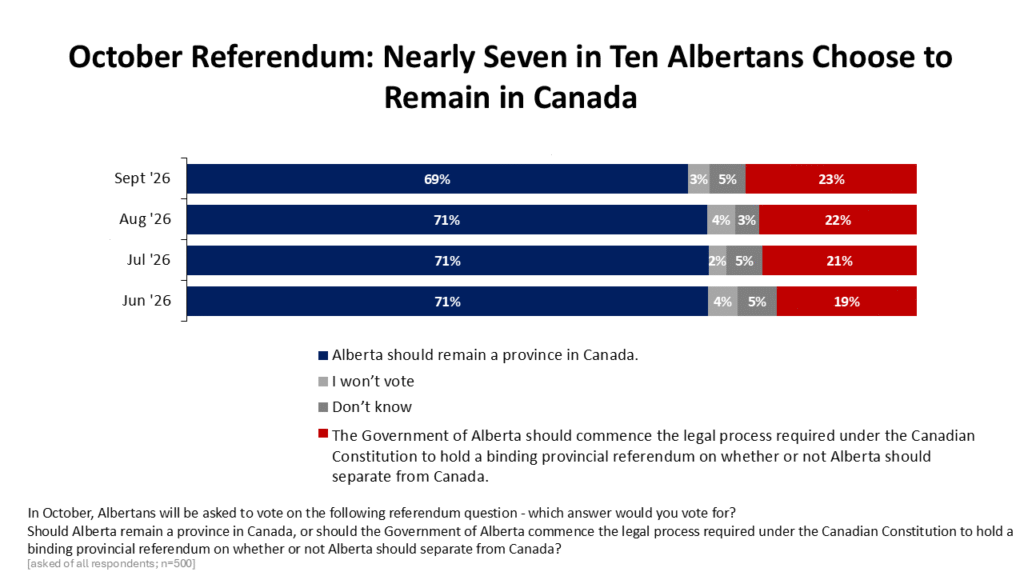
In short, Premier Smith is seeing both her personal popularity and the popularity of her government slide as the separatism discussion boils along – without actually moving the needle on support for either referendum option. We will be watching carefully to see if this negative trend among UCP voters continues as both the referendum and the UCP AGM in November grow closer.