Canadians are increasingly concerned about the consequences of a trade war with America, but they are blaming Washington, not Ottawa.
These results are drawn from an online survey sponsored and conducted by Innovative Research Group between August 21st and 25th, 2026. The survey interviewed n=1,345 Canadian citizens, 18 years or older, and the results are weighted to n=1,200 based on Census data from Statistics Canada. Results are weighted by age, gender, region, education, and self-reported federal vote to ensure the overall sample’s composition reflects the actual population according to Census data.
Following last week’s dramatic last-minute breakdown in the Canada-U.S. trade negotiations in Washington, INNOVATIVE went into the field to see how Canadians were feeling about the crisis, who they thought was responsible, and what the impact has been on the broader political environment so far.
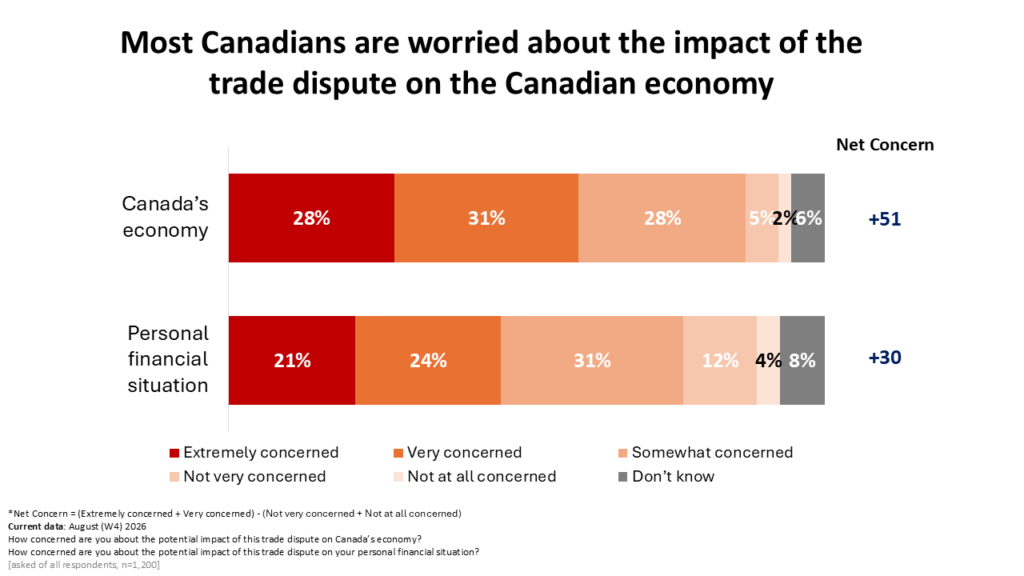
Canadians look somewhat more worried about the economic consequences of the dispute than last year, even after President Trump’s April “liberation day” tariff announcements. Currently, 59% are very/extremely concerned about the impact of the trade dispute on Canada’s economy. Canadians’ concern for the impact on their personal finances remains lower, however, at 46% very/somewhat concerned.
With that in mind, Canadians are largely blaming the U.S., not Ottawa, with 62% saying the US would be most to blame if no agreement is reached compared to only 13% saying Canada. Canadians continue to report anger toward Trump, with 63% choosing that emotion to describe their feelings when thinking of how President Trump is treating Canada.
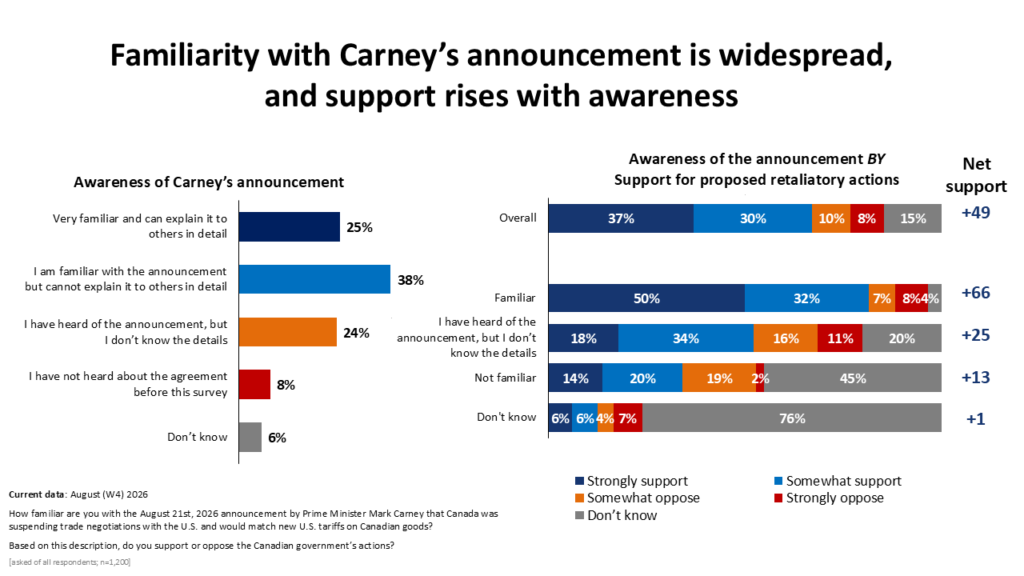
Almost two-thirds of Canadians (63%) report being familiar with Prime Minister Carney’s announcement, and support for the government’s proposed actions increases the more familiar Canadians are with them. Those who are very familiar with the Prime Minister’s announcement show a net support for the proposed responses of +66; those who were not familiar showed only a +13.
So far, the political impact of the trade suspension is limited.
The biggest impact is on approval of how the federal government is responding to Trump. Approval jumped from 41% earlier in August to 52% now. Older Canadians are by far more likely to approve of how the government is responding to Trump.
The other major gain is in approval for Mark Carney’s changes, which is up 8 points on net direction, with right track at 54%.
Other government approval and political measures have experienced smaller gains or, in a few cases, stability. For instance:
- Mark Carney’s favourables are up 4 points to +20.
- Carney has grown his lead over Pierre Poilievre by 3 points since the beginning of August. 40% now prefer Carney as best PM over 27% for Poilievre.
- Carney’s lead as best to handle Canada-US relations is up 3 points since July, with Carney at 50% and Poilievre at 27%.
Carney’s gains appear to be based more on what he is doing right rather than what Poilievre is doing wrong.
When we look at whether Canadians approve of the way Pierre Poilievre and the CPC are responding to Donald Trump, net approval is at zero, up 11 points from January but lower than in the campaign window. Most Canadians (47%) have no firm impression of Pierre Poilievre and the CPC on this issue. While not great, it is better for the Conservatives to deal with a blank slate on this issue than to deal with a negative view.
Click here to read the full report!