

On measure after measure, opinions regarding Ontario’s electricity sector are at all-time highs. Support has received a boost as Ontarians see the sector as a key bulwark in Canada’s defence against Donald Trump. The question is what happens after Donald Trump leaves, yet prices continue to rise? INNOVATIVE President Greg Lyle showed how attendees at the Ontario Energy Conference can make a difference now to prepare for that challenging future.
INNOVATIVE RESEARCH GROUP’s President, Greg Lyle, was invited by the Association of Power Producers of Ontario and the Ontario Energy Association to speak at their annual joint conference on October 13th. That presentation built on INNOVATIVE’s ongoing Canada This Month online public affairs survey, conducted and sponsored by INNOVATIVE. The presentation focused particularly on new results from a survey conducted between October 2 and October 6, 2026, with n=641 Ontarians, weighted to n=600. Results are weighted by age, gender, region, education, and self-reported past federal vote to ensure the overall sample’s composition reflects the population, according to Census and election data.
Trade pressure has created an appetite to build
The trade dispute with the United States has helped create a receptive environment for investment and construction. In September, 64% of Canadians agreed that fast-tracking infrastructure and natural resource projects is necessary to respond to U.S. trade pressure. A majority (52%) also agreed that projects important to the economy are getting built.
That sentiment extends to the Ontario government as well. In September, 55% approved of the provincial government’s response to issues resulting from Donald Trump’s presidency, up from 44% in August. Ontarians want to see the provincial government respond to Trump by Building Stronger here and abroad.
Electricity is part of that opportunity
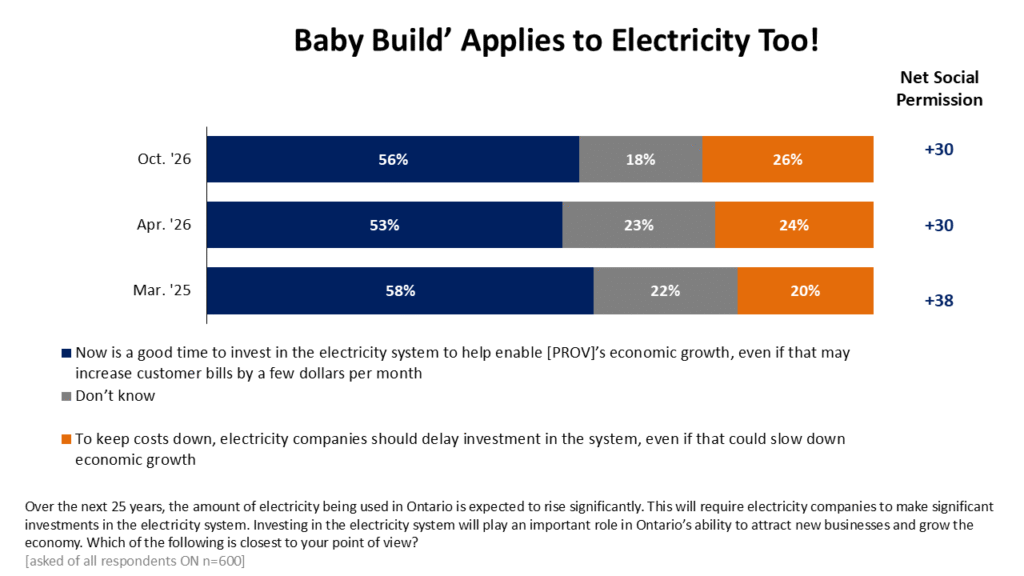
A majority of Ontarians connect electricity investment with economic growth. In October, 56% said now is a good time to invest in the electricity system, even if doing so increases customer bills by a few dollars a month, vs. 26% preferred delaying investment to keep costs down, even if that slows economic growth.
Concern about future supply has also become more widespread. The share who believe Ontario faces an electricity shortage when considering future economic growth reached 28%, up from 9% in March 2025. However, 45% still believe the province has enough electricity or a surplus, and 27% do not know enough to say. The need for expansion is gaining recognition, but more awareness is required.
The sector enters this moment from a stronger position
Across a variety of measures, Ontario’s electricity sector is at or near its strongest recorded standing.
- Nearly half of Ontarians (48%) are satisfied with the provincial government’s management of the electricity system, the highest level in the tracking.
- Perceptions of current electricity prices have also improved. Just over half (52%) describe what they pay as either the right amount or a good deal, while 33% call it a bad deal. In June 2018, 61% considered their electricity prices a bad deal.
- Electricity companies share in this stronger reputation. Around 57% hold favourable impressions of generation, transmission and local distribution companies, with relatively little distinction between them.
- Customer outcomes such as being seen as a valued customer and being protected in terms of reliability and quality are also peaking.
Support for investment comes with conditions
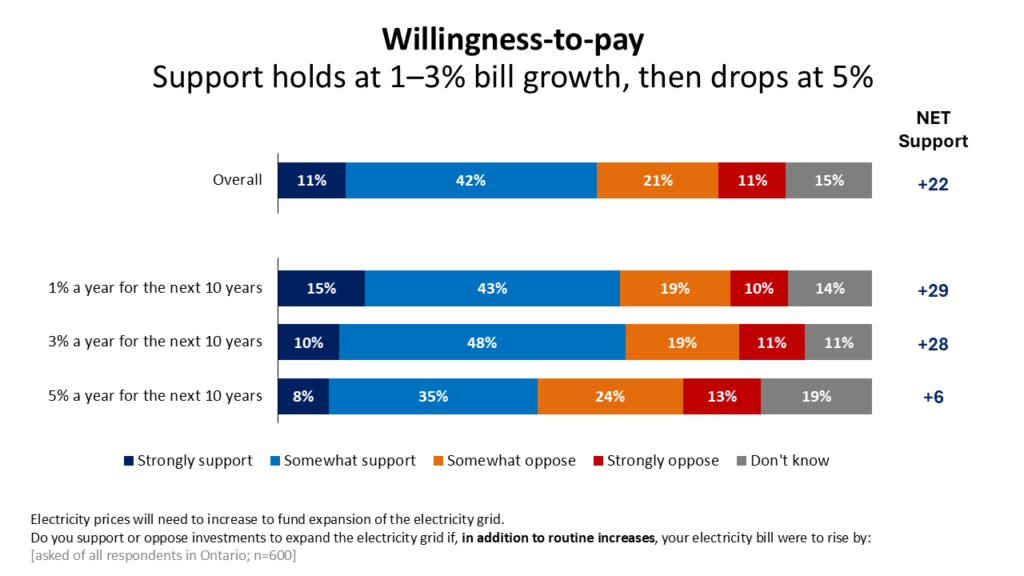
INNOVATIVE tested three scenarios with different levels of price increase to fund grid expansion. Across the bill increases tested, 54% supported paying more to expand the grid, while 32% opposed. The size of the increase matters: support stood at 58% for an additional 1% annually over ten years and 58% for 3%, compared with just 44% for 5%. These increases were explicitly described as additional to routine increases.
There are things the sector can do now to build support for future rate increases
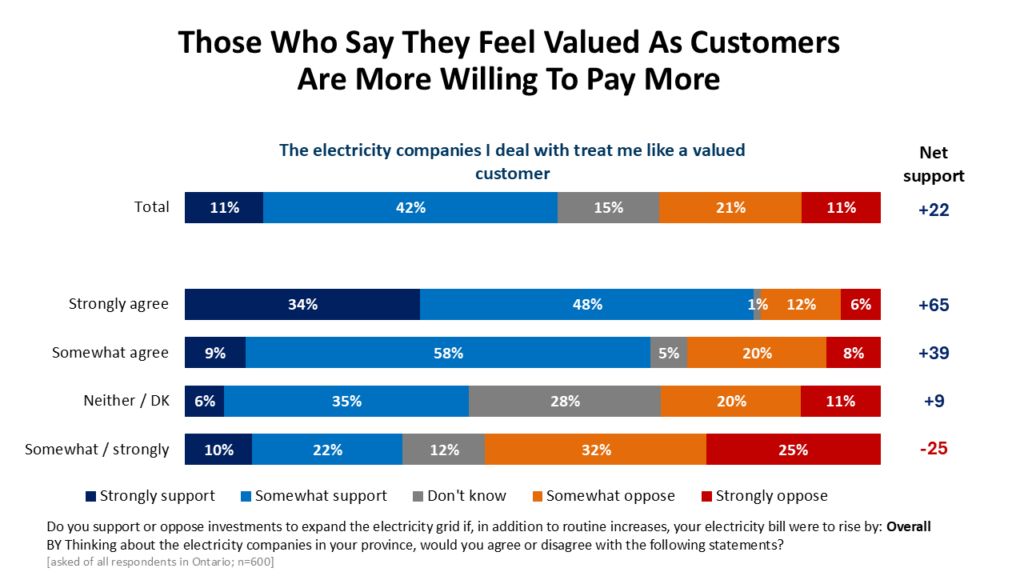
Virtually every job in the electricity sector impacts a customer belief that drives willingness to pay:
- Being treated as a valued customer, a belief impacted by every customer touchpoint, has a significant impact. 82% of those who strongly agree they feel treated as valued customers are willing to pay more, compared with 31% among those who disagreed.
- Making full use of existing assets, a key deliverable for the operations side of utilities, is also a key driver. Support for higher bills reached 85% among those who strongly agreed that electricity companies make good use of the existing system, compared with 30% among those who disagreed.
- The same relationship was seen for feeling supported on conservation and efficiency, feeling protected regarding reliability, as well as feeling protected in terms of price.
Ontario’s electricity sector has been lifted to new highs, both through its own efforts and through external events. As the sector waits for the Trump effect to recede while prices increase, the everyday activities of providing excellent customer service, finding efficiencies, and delivering safe, reliable power can help re-enforce the public opinion gains documented in these slides.