
INNOVATIVE’s tracking shows Canadians are broadly accepting of government changes to approval processes, but awareness of specific changes is low.
These results are drawn from an online survey sponsored and conducted by Innovative Research Group between May 15th and May 20th, 2026. The survey interviewed n=1,479 Canadian adults, 18 years or older, and the results are weighted to n=1000 based on Census data from Statistics Canada. Results are weighted by age, gender, region, and past vote to ensure that the overall sample’s composition reflects that of the actual population according to Census data.
The past few weeks have been a busy time for federal announcements on energy and natural resources. We have been tracking reaction to the government’s changes and dived deeper into the Ottawa-Alberta MOU and recent process reform announcements.
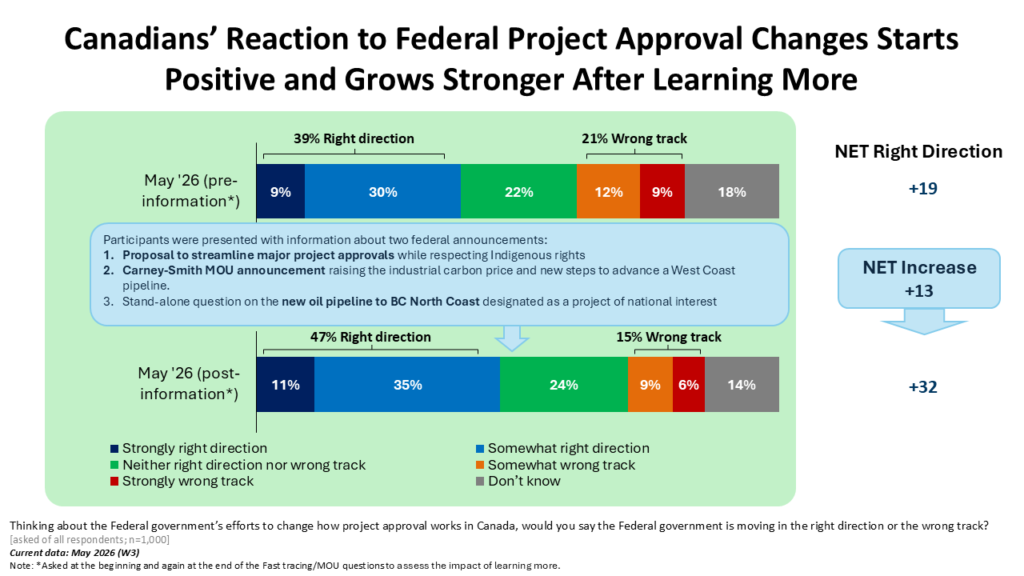
Before asking about detailed policies, we asked Canadians whether the government’s efforts to change project approval are headed in the right direction or are on the wrong track. Almost twice as many say right direction (39% to 21%).
Looking at the MOU and process reform announcements, we find low awareness. Just 4% are familiar with the details of the regulatory reform announcement, and only 7% familiar with the details of the MOU.
Awareness of this limited means new information can have a significant impact on lightly held positive reactions to the federal government’s energy initiatives. Environmental activists such as former Liberal Minister Steven Gilbeault still have an opportunity to frame the government’s action in a negative light and turn the initial positive reactions into negative ones. Ottawa and Edmonton, and actors who support the federal government’s initiatives, should not take this initial support for granted.
Reactions to the carbon tax price increase show the difficult challenge facing the feds. While the largest share of Canadians (32%) say raising the carbon price is a good compromise, 27% say imposing a carbon tax hurts the economy, while 18% said that the carbon price plan is too little too late. However, this fragmentation was the exception.
That warning aside, Canadians had an overall positive reaction to the May 15th MOU announcement. 32% said the announcement was mostly or all good, with 13% saying mostly or all bad. More than half the country either have mixed views (37%) or remain uncertain (18%). Again, government communicators and supporters of the MOU have work to do.
Canadians also like what they are hearing about the government’s May 6th announcement to make it easier for natural resource projects to be approved and built faster.
When asked about the federal government’s project approvals, a plurality supports the government’s direction. Before responding to specific initiatives, 39% say the federal gov’t is on the right track on project approvals (net +19). After hearing about specific federal efforts, the right direction rises to 47%, and net support jumps to +32, a 13-point information-driven gain. Learning more strengthens support, which is good news for Ottawa and Edmonton as well as project proponents.
Overall, the federal government is in a pretty good position when it comes to early reaction to its energy and natural resource initiatives. But many remain conflicted or uncertain, and those who are onside base their views on limited information. With motivated opponents such as the former Minister Steven Gilbeault, this story is far from over.
Click here to read the full report!