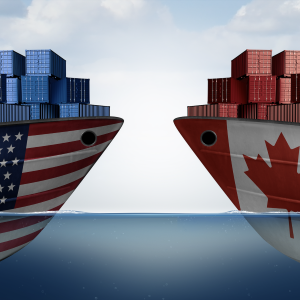
INNOVATIVE’s tracking finds Canadians consistently more likely to say the government is moving too slowly than too fast.
These results are drawn from an online survey sponsored and conducted by Innovative Research Group between March 6th and March 31st, 2026, of adult Canadians. The survey interviewed n=5,224 Canadian adults, 18 years or older, and the results are weighted to n=2000 based on Census data from Statistics Canada. Results are weighted by age, gender, region, and past vote to ensure that the overall sample’s composition reflects that of the actual population according to Census data.
On Friday, May 15, we saw Prime Minister Carney and Premier Smith announced a climate and energy agreement which builds on the memorandum of understanding that the Alberta and federal governments signed in November 2025. This agreement would see Alberta submit a proposal for a new oil pipeline to the major projects office by July 1, with the federal government designating it as a project of national interest by Oct. 1. Both parties are hoping this will result in increased energy investment, as well as providing political benefits to both governments.
How much attention are Canadians paying to this process, and why are we seeing two major announcements on resource development from the Prime Minister inside a week?
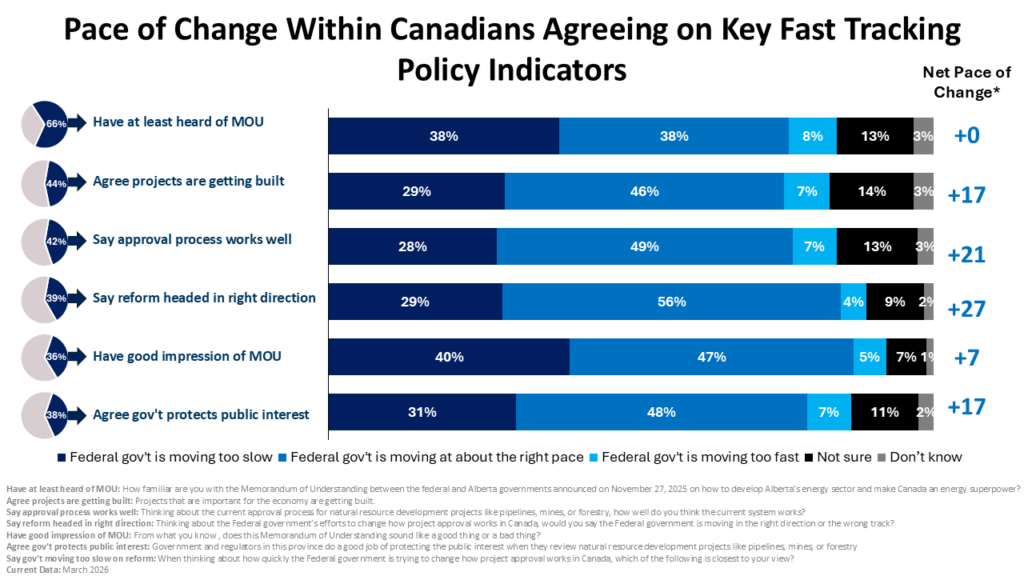
To begin with, while there is growing awareness of the MOU, it remains somewhat polarizing. Casual awareness of the MOU rose 7 points (from 32% in late 2025 to 39% in March 2026), with 66% having at least heard of it. However, only 27% of respondents said they are truly familiar. Those who know it best are most likely to view it favourably (57% good), while casual awareness skews toward mixed impressions (42% “mix of good and bad”).
More importantly, ever since June, Canadians have been more likely to say the federal government is moving too slowly on this file than moving too fast. No matter how we look at the government’s efforts on resource development and major projects, Canadians are quite consistent in toward greater speed over less. Even among the supporters of reforms, a substantial number (~30%) say government action is moving too slowly.
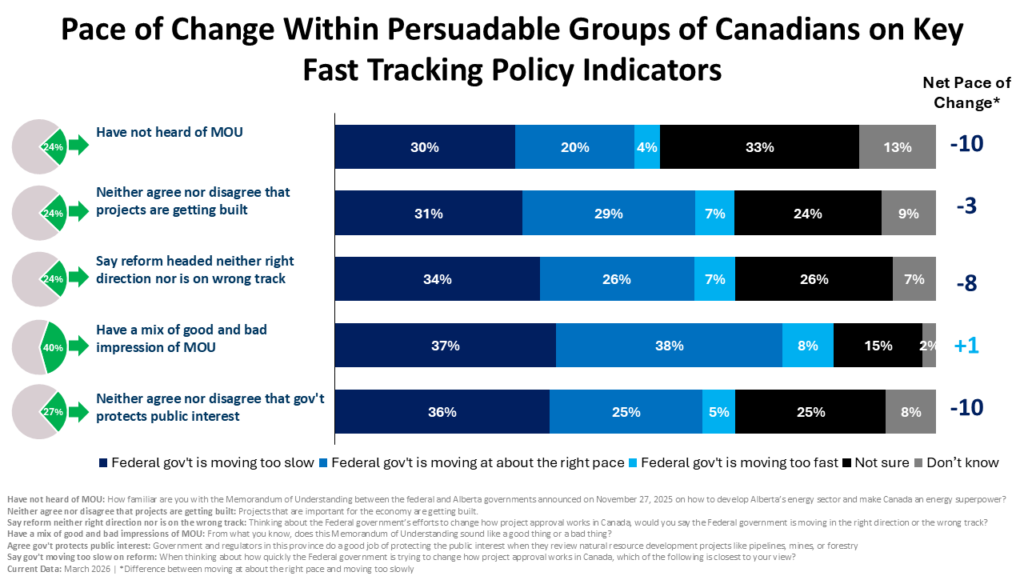
Among persuadable Canadians, this number is even higher:
In particular, this unites the West; it is not just Alberta, but BC and the rest of the Prairies as well. Unsurprisingly, Albertans are most invested, and familiarity with the MOU is highest there (34%), as is the positive reception (43% good). Albertans’ perception of grievance has remained unchanged since November of 2025, with 69% of Albertans feeling that the province has been treated unfairly by Ottawa. That sense of grievance has subsided slightly (9 points If we look at the net since November) driven by a 10-point rise in the share who believe Alberta has been treated fairly.
Perhaps the MOU is doing some work, but Canadians are clearly expecting more changes, and soon. In particular, those who are uncertain about the MOU at this point are notably more likely to be dissatisfied with the pace of change. The Prime Minister apparently understands that expectation and will have been in front of the cameras several times this week trying to address it. We’ll see if the announcements move the needle.
Click here to read the full report!