
Since Carney’s Davos speech, leadership evaluations and federal approval were moving — but the ballot was not. That has now changed as the Liberals have moved into a clear lead. Crucially, however, this shift is being driven by gains from the NDP and undecided, not from Conservative losses.
These results are drawn from an online survey conducted between February 06 to 17, 2026, sponsored and conducted by Innovative Research Group. The survey interviewed n = 1,838 Canadian citizens aged 18 and older, with results nationally weighted to n = 1,000 by age, gender, region, education, and self‑reported past federal vote to ensure the sample reflects Census population benchmarks.
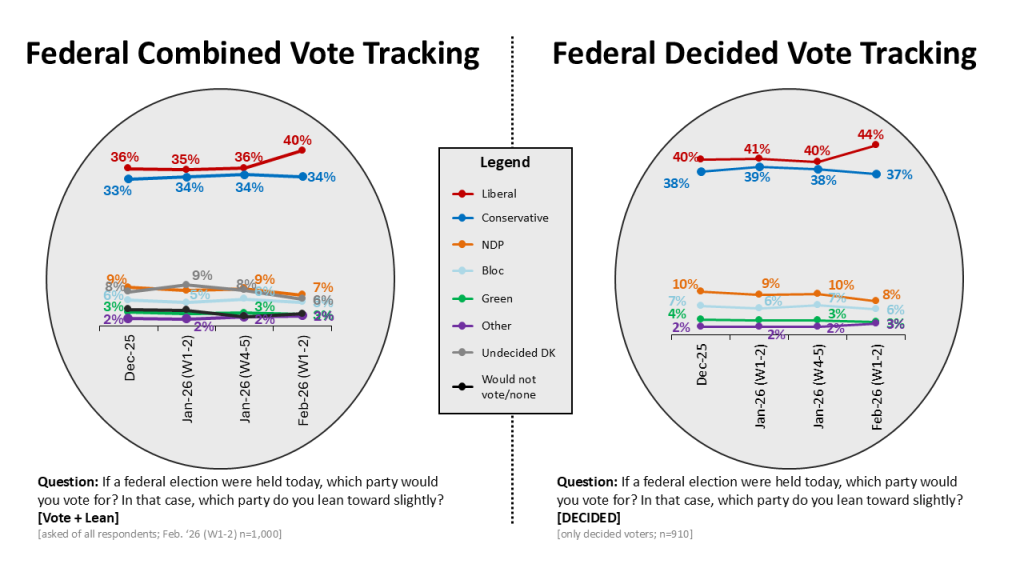
Our latest Innovative Research tracking survey shows a four-point Liberal decided vote increase compared to the previous wave (40% post-Davos vs 44% now), compared to a steady Conservative vote (38% post-Davos vs 37% now), resulting in Liberals breaking out of a tight race, opening a 6-point lead over the Conservatives.
That stability of the Conservative vote is the key to understanding what is happening.
We have two ways of looking at the vote. The combined vote includes undecided and shows what you would find if you stop 100 people on the street. Decided vote takes the undecided and would not vote respondents out and only shows people with a current vote preference. This allows us to compare more easily to previous election results.
If Conservatives were bleeding support, we would see their combined vote decline. We do not. Conservative combined support has held structurally intact at 34% of all voters. There is no measurable evidence of base erosion.
Instead, the shift appears to reflect Liberal gains from the uncommitted and NDP.
Uncommitted voters have declined as attention to Canada–U.S. tensions intensified. At the same time, NDP support shows modest softening parallel to Liberal growth. The pattern shows uncommitted and NDP voters breaking toward the Liberals, not with Conservatives switching sides.
This consolidation follows broader strengthening in underlying numbers following Carney’s Davos speech, which we reported earlier.
Several indicators moved before the ballot did:
- 50% now say Mark Carney is best to handle Canada–U.S. relations, compared to 25% for Pierre Poilievre, an 8-point gain since January.
- Federal approval on Trump-related issues stands at +21 net, a 10-point lift from pre-Davos levels.
- Overall satisfaction with the federal government sits at +14 net, up 9 points post-speech.
- Among the 48% of Canadians recently exposed to coverage of the Prime Minister and federal government, 56% report feeling more favourable, compared to 18% less favourable. Since most news is bad news, this level of positive impact from the political debate is remarkable.
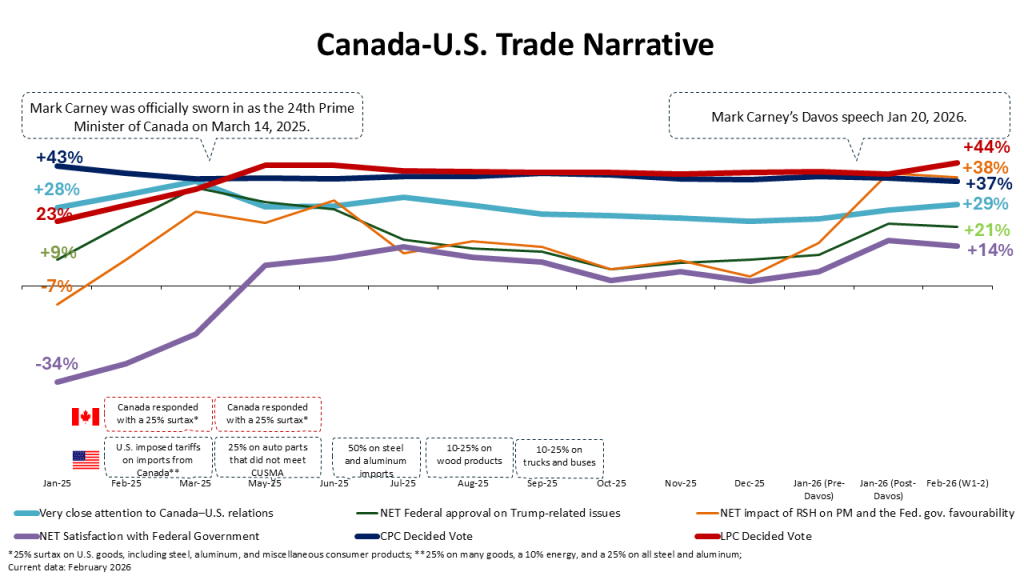
For months, there was divergence between leadership perceptions and ballot intention. Carney outperformed on the defining international issue of the moment, yet the vote remained tight. What we are now observing is convergence. The ballot appears to be catching up to the leadership reality voters were already describing.
This does not suggest that one speech will result in a permanent gain. Carney’s Trump numbers were softening prior to Davos. The forces that contributed to that decline remain in place. But it likely reveals the dynamic we can expect if we see a 2026 election. Voters outside the Conservative base rally to Carney and the Liberals as their best option to defend against Trump.
So while it is good news for the CPC that they do not currently appear to be losing voters to the Liberals, the bad news for the CPC is that the Trump dynamic allows the Liberals access to a larger pool of voters than is available to the Conservatives.