Canadians are more likely to agree with pro-civility attitudes than unbridled self-expression. But that consensus is fraying among younger Canadians.
These results are drawn from an online survey conducted between January 16 and February 2, 2026, sponsored and conducted by Innovative Research Group. The survey interviewed n = 2,572 Canadian citizens aged 18 and older, with results nationally weighted to n = 1,500 by age, gender, region, education, and self‑reported past federal vote to ensure the sample reflects Census population benchmarks.
High Importance, Moderate Familiarity
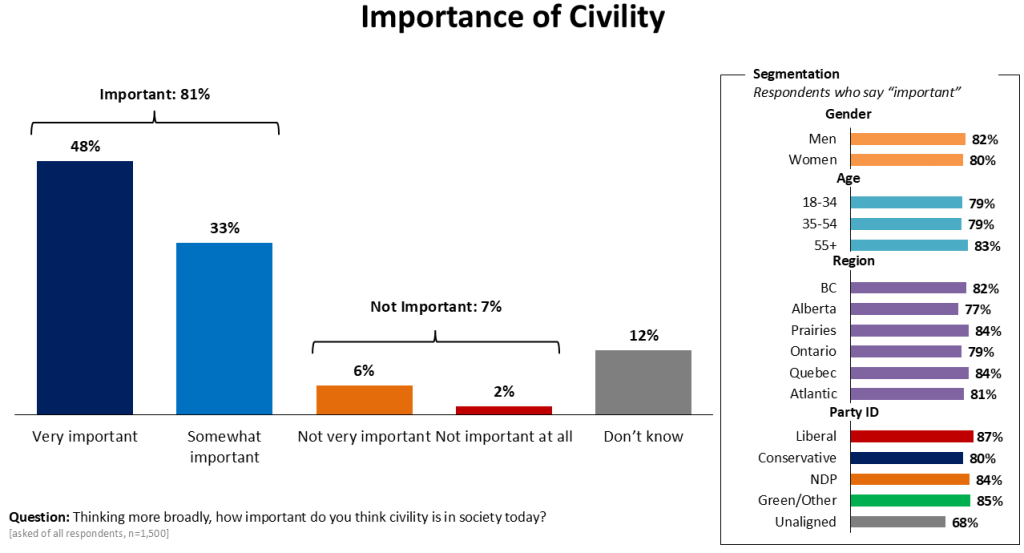
While only 56% say they are familiar with “civility in politics,” 81% consider it important. This suggests that civility operates less as an active idea and more as a social instinct.
Canadians broadly agree that civility matters, but the strength of the consensus varies across provinces:
- Prairies and Quebec register the strongest importance scores (84% range)
- British Columbia and Atlantic Canada sit close to the national average
- Ontario and Alberta both fall below the national average with importance scores in the high 70% range; a strong majority, but comparatively more open to conviction-first argument.
The core of the civility consensus
It’s hard to run a democracy without an agreement to disagree, so its good news that this one statement stands out as a near universal belief:
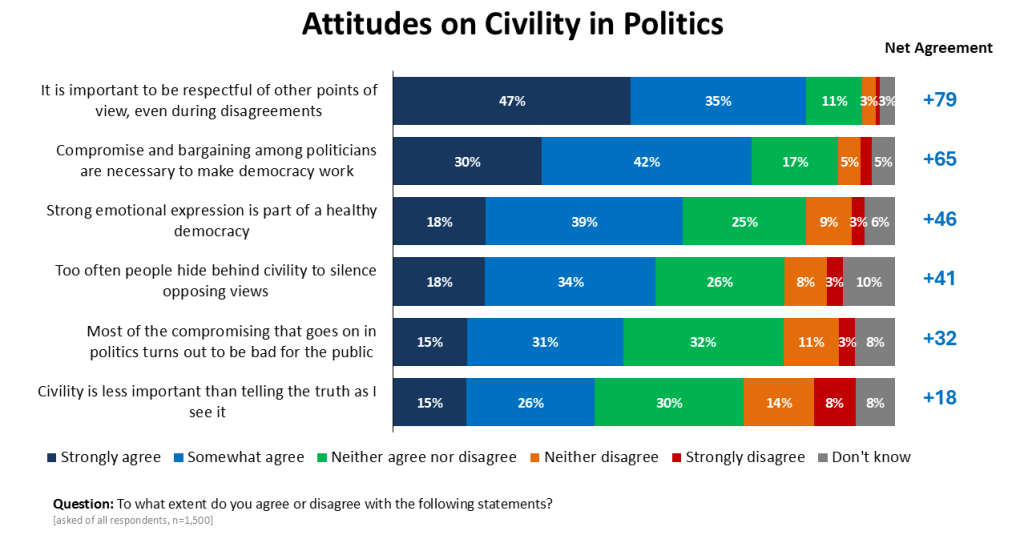
- 82% agree it is important to respect other points of view, even during disagreements.
We also ran two items we previously asked in 2022 about compromise in politics. More people agree that compromise in politics is necessary while fewer agree that most political compromise is bad for the public.
- 71% agree that compromise among politicians is necessary for democracy. This is up 13-points from 2022.
- 46% agree that most political compromise is bad for the public, down 5 points from 2022.
There is an important age gap on these items. Agreement that compromise is necessary is strongest among Canadians aged 55+ (79%), who outpace younger adults by 17 percent. There is a smaller but still significant difference on agreement with the belief that most compromises are bad for the public with younger people (51%) 13 points higher than older voters (39%).
Civility and Self-Expression
Passion is not seen as incivility. A majority (58%) of Canadians agree that strong emotional expression is part of a healthy democracy. All ages share this belief.
There is some skepticism about the potential for civility to suppress dissent. A slight majority (52%) say people sometimes hide behind civility to silence opposing views. Once again, we see a significant age gap with 59% of under 35s agreeing and only 46% of over 55s agreeing.
Finally, a plurality of 40% agree that civility is less important than telling the truth as I see it. Interestingly, agreement with this statement is similar across all age groups.
Comparing Personal Preference on Civility vs Perceptions of Leaders
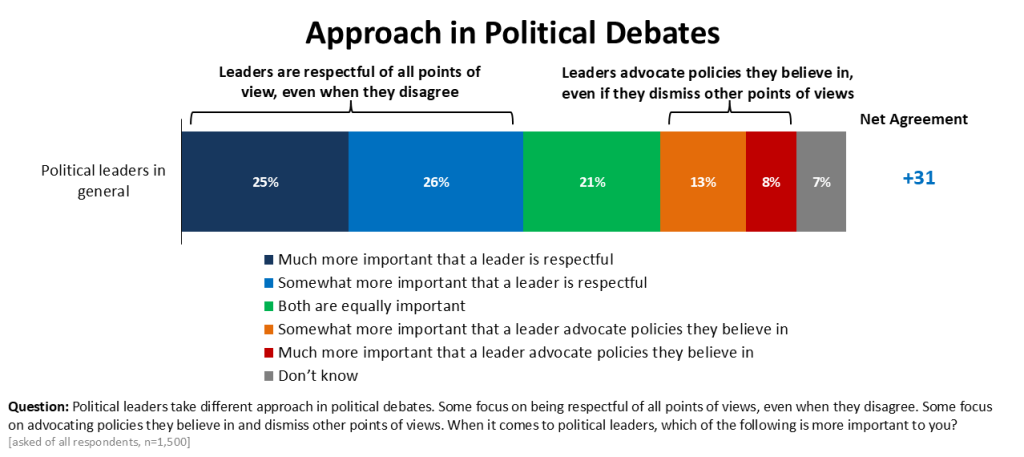
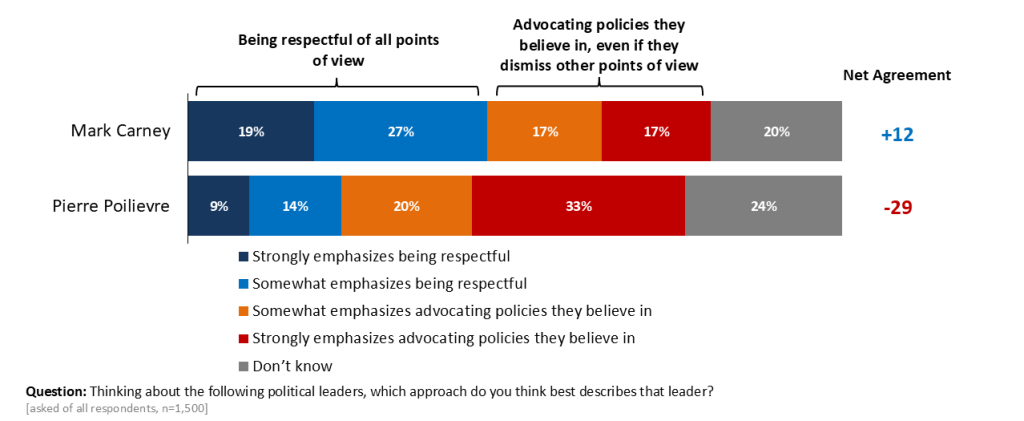
To get a sense of the relative priority of respect for all points of view versus advocacy, we asked respondents to indicate which they felt was more important for leaders and then asked them to assess which is more important to Mark Carney and Pierre Poilievre:
- 51% say it is more important for leaders to be respectful.
- 21% say it is more important for leaders to advocate strongly.
- The rest view both as equally important.
Older voters are more likely to chose respect over advocacy as do Liberals and New Democrats.
Voters who give priority to respect are 10 points more likely to vote Liberal than CPC. Voters who priories advocacy are 11 points more likely to vote CPC than Liberal.
The public see the two leaders as very different on this choice:
- Mark Carney is more often seen as emphasizing respect (46%) than advocacy (34%).
- Pierre Poilievre is more often seen as emphasizing advocacy (53%) over respect (23%).
Summing It Up
There is a core consensus around civility that bodes well for Canadian democracy. The vast majority believe we need to respect different points of view, even when we disagree. Most Canadians also agree that compromise is necessary to make democracy work.
That doesn’t mean there isn’t room for passion. A strong majority say strong emotional expression is part of a healthy democracy. Some are willing to go as far as saying civility is less important that telling the truth as I see it.
We also find some skepticism about civility and compromise. A majority agree too often people hide behind civility to silence opposing views and just shy of a majority are concerned that compromises are bad for the public.
While there is a broad consensus, there are some important differences. Young people are more skeptical, perhaps because they feel like their needs are not being addressed by our political system. And while many Conservatives agree with beliefs about civility, Liberals and New Democrats are more likely to give them priority over advocacy.