
In our last blog post, we showed that culture is emerging as a critically important dimension in Canadian politics. In this post, we focus on cultural alienation and anti-elite resentment, which reflect the views of more Canadians than you may think.
These are the results of an online survey conducted between December 4th to 14th, 2025, sponsored and conducted by INNOVATIVE RESEARCH GROUP. This survey interviewed n=2,159 Canadian citizens, 18 years or older. Because of regional oversamples, the results are nationally weighted to n=1,500. Results are weighted by age, gender, region, education, and self-reported federal past vote to ensure that the overall sample’s composition reflects that of the actual population according to Census data.
Culture Wars
Everywhere we look, we see opinion pieces and panels assert that Mark Carney and the Liberals are having political successes and Pierre Poilievre and the Conservatives are making mistakes. Yet the vote remains very tight. In fact, the Conservatives are winning more centre left votes than expected.
One area where Poilievre has been particularly criticized is culture. To understand why Poilievre keeps bringing back cultural issues, we set out to probe whether Canadians resonate with his discourse. We asked Canadians’ opinions on how things fare in six areas related to institutions and identity, and we found that they are fairly pessimistic.
- 71% agree that Canadian elites don’t care about ordinary Canadians.
- 61% agree that Canada is headed down a road that will leave a mess for future generations.
- 59% agree Canadians have lost a shared sense of who we are.
- 55% agree Canadian institutions are broken.
Strikingly, given a choice, 54% of Canadians say that the system is rigged “to benefit Canada’s elites at the expense of average Canadians” while only 30% say average Canadians are well served.
While 49% say we have the right balance between teaching pride in Canadian history vs acknowledging mistakes, twice as many (27%) say there should be more focus on building pride than say there should be more focus on acknowledging mistakes (14%).
When we group Canadians based on those opinions on institutions and identity, they tend to cluster into four groups:
- Culturally Alienated (28%): Canadians who believe institutions are broken, elites are disconnected, our shared identity is lost, and the country is headed toward crisis.
- Anti-Elite Populists (29%): Canadians who believe elites don’t care about average people and the system is rigged in their favour.
- Moderate Pessimists (29%): Institutions and elites have problems, but the system is not “rigged”. Identity and future outlook are concerning but not collapsed.
- Status Quo Supporters (15%): A generally trusting and low-cynicism group.
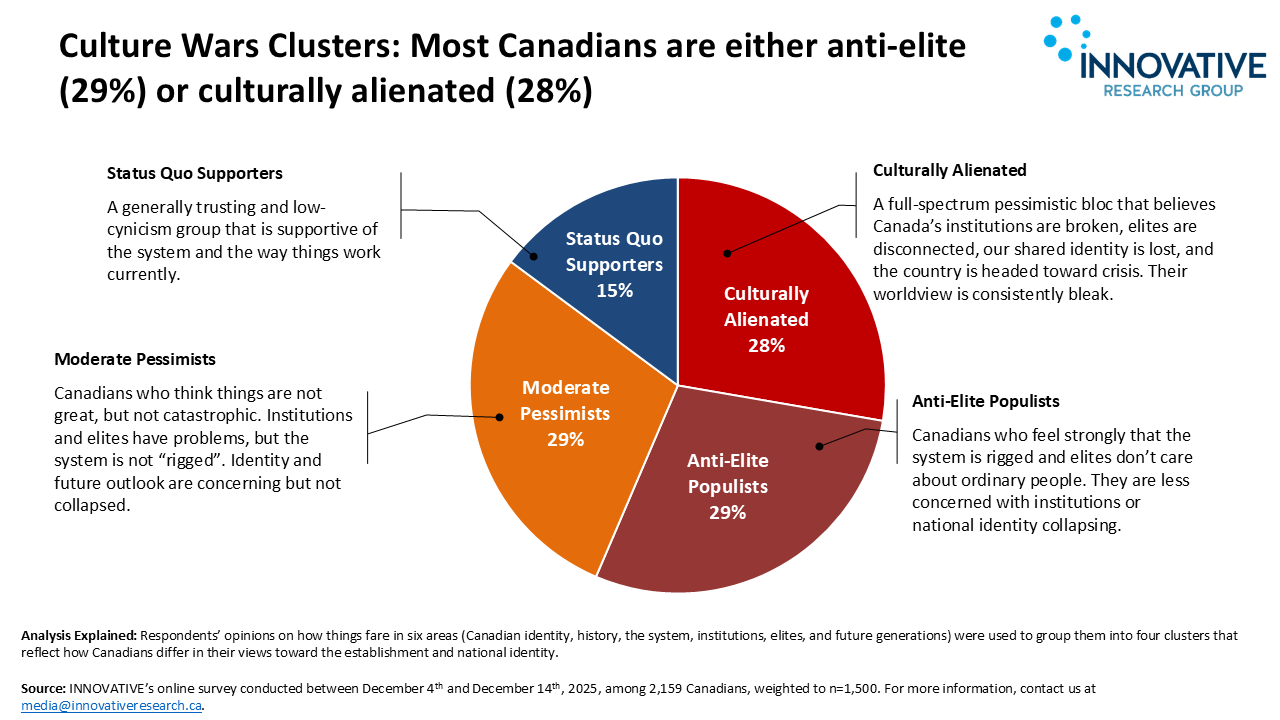
Our results also help explain why the CPC is drawing more votes than we would expect from the centre left, with 31% of decided voters choosing the CPC among Left Liberals, and 25% among the Core Left. We find that 3-in-10 in these two groups on the Left tend to be culturally alienated, and 4-in-10 can be characterized as anti-elite populists.
This is reflected in the vote intentions of decided and leaning voters. 57% of the Culturally Alienated—who represent 3-in-10 voters—would vote for the Conservatives. Among Anti-Elite Populists, who make up another substantial voter share, Conservatives are trailing the Liberals by only 4 points at 28%.
Given that the Liberal Party and the Conservative Party are tied in vote intentions at 39%, if Poilievre can capitalize on anti-elite resentment and cultural alienation—and does it the right way—it could open a path to winning the next election.
Party Brands
While there is a slight drift towards the Liberals, generally the brands of the two main parties are very similar to where they were as the election was wrapping up. The Liberal brand remains strong on climate change and women’s rights, where they are ahead of the Conservatives by a wide margin. However, on issues that Canadians seem to care more about these days, like housing affordability and helping ordinary Canadians get ahead, the Conservatives are leading Liberals, and by +7 and +6 points respectively.
One exception to the general pattern is Trump. On making things better in standing up to Trump, Liberals lead the Conservatives by 11 points with a net score of +13. However, Liberals have lost ground on this issue compared to April, when they were scoring at +23.
Leader Brands
Carney has gained a significant advantage over Poilievre since the election. More Canadians favour Carney on “competent”, “strong leadership”, and “capable of standing up to Trump” than Poilievre. Carney leads by at least 8 points, which is roughly double his lead at the end of the election.
While Poilievre remains relatively strong on “cares about people like me” and “stands up to special interests,” Carney is now tied on these measures.
Most strikingly, the Prime Minister has a 4-point lead on representing positive change.
The Bottom Line
Canadian exceptionalism on culture is over. Canadians are increasingly mad as hell and not willing to take it anymore.
Cultural alienation already seems to be helping the Conservative party break into centre left value clusters.
But while cultural alienation is growing and helping the Conservative Party, Poilievre is actually losing ground.
That raises questions. If cultural alienation makes sense strategically and the CPC is generally holding its own, why is Carney gaining ground while Poilievre is treading water? Is Poilievre doing something wrong, or is Carney just doing things right?
We know from our election polling that Canadians did not like Poilievre’s Trump-like delivery, even if they seem to agree with him on his cultural message. The challenge for Poilievre is a tall order: crafting a Trump-like coalition of voters on the Left and on the Right, and doing it without sounding too much like Trump.
At a deeper level, our findings suggest that cultural alienation is more than a political problem. The Canada that exists today is not the Canada of even five years ago. If Canada’s leaders are not seen to be delivering for average Canadians, we can expect disruption not just in politics, but throughout society.