With his resignation, Francis Legault hoped to give the CAQ an opportunity to rebound with a new leader. While the future can always bring surprises, on first blush it appears Quebec voters are unlikely to give the CAQ a second chance despite their concerns over the PQ and its referendum promise.
These are the results of an online survey conducted between January 16, 2026, to February 1, 2026, sponsored and conducted by INNOVATIVE RESEARCH GROUP. This survey interviewed n=651 Quebec citizens, 18 years or older. The results for Quebec are weighted to n=600 by age, gender, region, language, education, and self-reported federal past vote to ensure that the overall sample’s composition reflects that of the actual population.
A Tough Verdict on the CAQ Record
The public mood toward the CAQ is bleak:
- More than seven in ten (71%) say it’s time for a change.
- Nearly six in ten Quebecers say they are dissatisfied with the provincial government.
- Close to half believe that CAQ governments have worsened Quebec’s economy, a tough blow for a party that once sold itself as a steady and competent manager.
The economy always matters, but especially in a context where 41% of Quebecers believe that Quebec offers everything needed to succeed yet they are finding it increasingly difficult to get by (“Strugglers”). These views help explain why Legault never recovered from the sharp drop in favourability he experienced in late 2022.
Legault’s sacrificial resignation doesn’t appear to offer much hope for the CAQ:
- Just 29% say they forgive CAQ’s mistakes and would consider voting for them.
- Just 22% say they are likely to vote CAQ even if the new leader implements some of the change they are looking for.
If there is potential for the CAQ to rebound, it appears to be among those aged 55 and over and among residents of the 450 region who are more inclined to forgive their mistakes.
PQ Momentum, but a Referendum Creates Vulnerability
Against this backdrop, the Parti Quebecois is benefiting from the CAQ’s decline.
- At 31%, the PQ have a 5-point lead in decided vote over the Liberals.
- The net impression of PQ leader Paul St-Pierre Plamondon stands at +9 points: positive, though well below his July 2024 peak of +20.
However, the sovereignty question continues to weigh on the party. More Quebecers oppose Quebec sovereignty than support it (net support stands at -27 points), a gap that has widened by 16 points since 2024. Most Quebecers believe a PQ government would make a referendum a priority and agree that doing so would distract from more pressing issues. The ironic good news for the PQ is that there is also skepticism about whether the party would follow through. More than a third of Quebecers, and half of CAQ partisans, think the PQ would ultimately step back from its commitment to hold a referendum if elected.
Who’s Struggling, and Who They’re Voting For
Vote intentions reveal a fractured electorate with sharp demographic and attitudinal divides. Men and francophones are more likely than average to support the PQ, while voters aged 55 and over and those living in Quebec City and Chaudière-Appalaches are more inclined toward the CAQ. The PQ remains relatively strong among its core base, with 60% of Quebec sovereigntists supporting the party.
In a context of growing economic anxiety, the economy is poised to be at the frontstage of the next elections. In this field, the PQ also seems to have an advantage as economic Strugglers, who represent 41% of the electorate, disproportionately back them. Naturally, the economic winners, the Achievers, are more likely to vote for a renewed CAQ government, but this segment only represents 1 in 5 voters. We also find that the PLQ is strongest among Alienated Quebecers who are struggling and have lost hope in the system (17%), which could open a potential line of attack for the party.
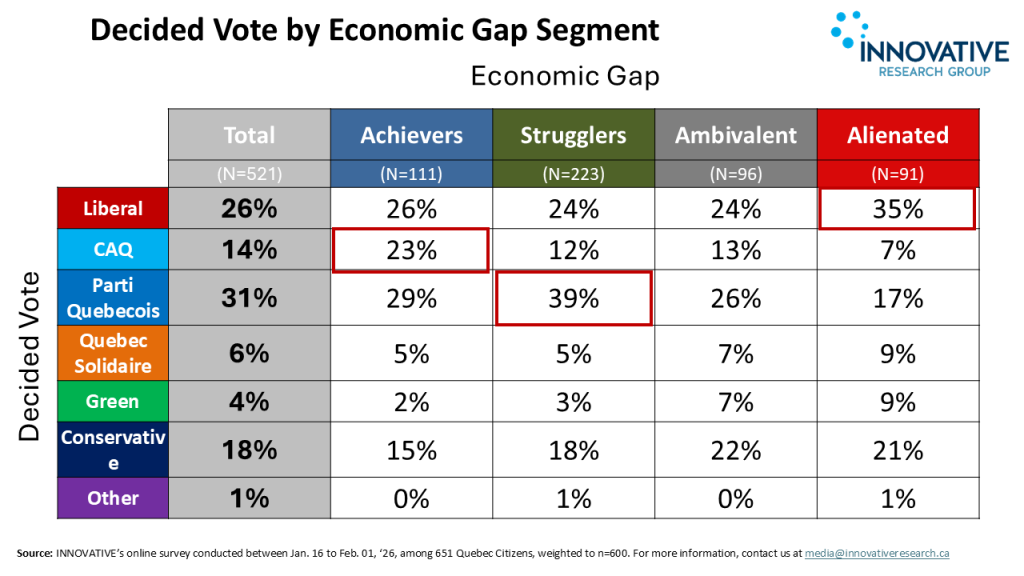
The CAQ now finds itself in fourth place with just 14% support among decided voters, trailing not only the PQ (31%) and Liberals (26%) but even the Conservatives at 18%. This positioning underscores how far the party has fallen, and how uncertain its path forward remains without Legault at the helm.
A New Political Era for Quebec
Quebec’s political map is taking a new shape. Deep dissatisfaction with the CAQ points to a steep road ahead for the CAQ as it seeks to regain the confidence of voters under new leadership. A new PLQ leader, and sovereignty remaining a complicated sell for the Parti Quebecois, means the PQ cannot take their current lead for granted. Sitting in third, the Conservatives stand ready if either the PLQ or PQ stumble.
Amid ongoing economic uncertainty, the economy is likely to be front and centre in the next election. In the past, economic issues tended to favour the Liberals and then the CAQ. Today, the PQ appears well positioned on this front, drawing disproportionate support from Quebecers who believe Quebec provides the opportunities to succeed, but are finding it increasingly harder to make ends meet.