
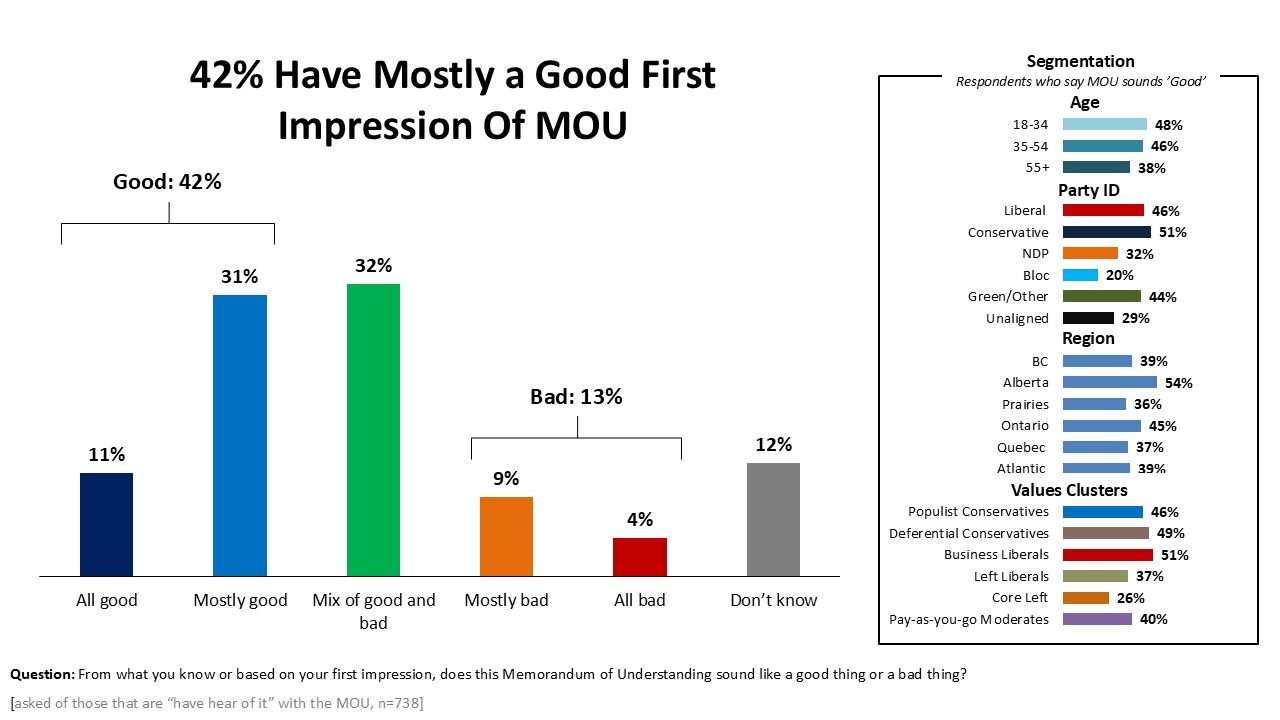
While only 27% are familiar with the MOU, those who are aware are more likely to see it as mostly good (42%) than as mostly bad (13%).
These are the results of an online survey conducted between November 27th, 2025 and December 1st, 2025, sponsored by INNOVATIVE. This survey interviewed n=1,846 Canadian citizens, 18 years or older. Because of regional oversamples, the results are nationally weighted to n=1,250. Results are weighted by age, gender, region, education, and self-reported federal past vote to ensure that the overall sample’s composition reflects that of the actual population according to Census data.
While this agreement has been front and centre in the political class and with the energy sector, it has generated low awareness among average Canadians. As noted, only 27% are familiar with the announced MOU, although another 32% have heard about it but don’t know the details. That means initial reactions should be fluid and open to change.
After the initial reaction, the survey included a summary based on the federal government release and then asked for an “aided” reaction. While response is a little less favourable (36% mostly good, 13% mostly bad), the difference is among people who are not familiar saying the agreement is a mix of good and bad.
The federal and Alberta governments can take comfort in the public’s reaction to pro and con arguments. A strong majority of Canadians (63%) said that their Memorandum of Understanding (MOU) is a good way to build a stronger Canada. In addition, a majority (58%) say the deal with help Alberta and the federal government build mutual trust and 57% say the agreement is a necessary compromise to move forward on energy policy.
Canadians are more concerned about process issues than the climate compromise. A majority (55%) say it was wrong to do this deal without BC while 52% say it was wrong to do the deal without Indigenous peoples. However, only 39% agree the MOU sacrifices too much on Canada’s climate commitments with 34% opposed.
On first blush, this MOU looks like it will help the Liberals more than hurt them. To fully implement the MOU, both Alberta and the federal government need to ensure process issues don’t derail the substantive consensus.
Click here to read the full report!