
Canadians want stability from their political leaders, and they want it by a clear margin. But when you look at how they actually perceive the two main leaders, the picture is less clear than you might expect.
These results are drawn from an online survey conducted between January 16 and February 2, 2026, sponsored and conducted by Innovative Research Group. The survey interviewed 2,572 Canadian citizens aged 18 and older, with results nationally weighted to n=1,500 by age, gender, region, education, and self‑reported past federal vote to ensure the sample reflects Census population benchmarks.
At INNOVATIVE, we don’t just track political toplines, we look for the underlying drivers of the political dynamic.
One theme we hear regularly from pundits is that Canadians are looking for stability, and a big part of Carney’s success is delivering the stability they are looking for.
Other work INNOVATIVE has done raised questions about whether that theory was true. We know that Canadians are looking for a change from Trudeau. Voters see Carney as a change agent and are happy with his changes.
We also know that a majority of Canadians are unhappy with the status quo and seem interested in shaking things up.
So, we decided to test the disruption versus stability frame to see how big a difference it really makes. We asked Canadians whether they personally wanted a leader who focused on stability or disruption, and then we asked them whether they think Carney and Poilievre prefer stability or disruption.
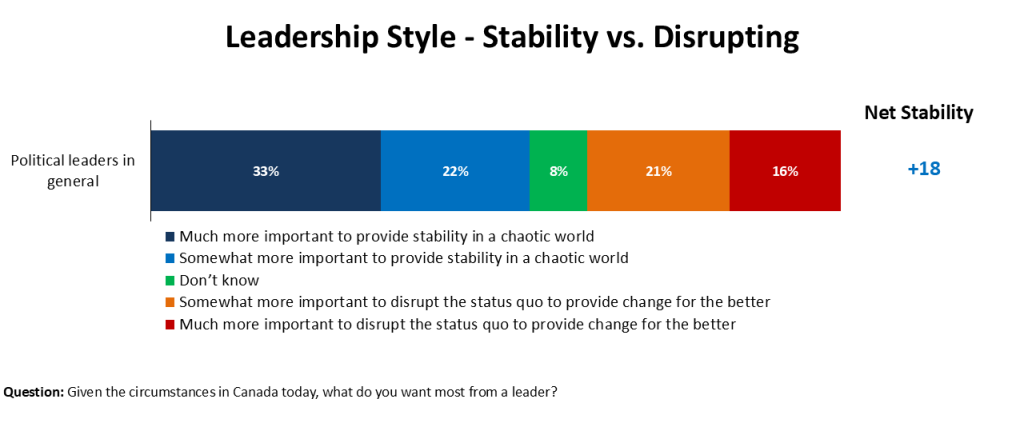
The first part of the pundits’ theory holds up. Canadians favour stability over disruption 55% to 37%, a preference that holds across gender, age, and region. The issue is when we look at perceptions of the leaders.
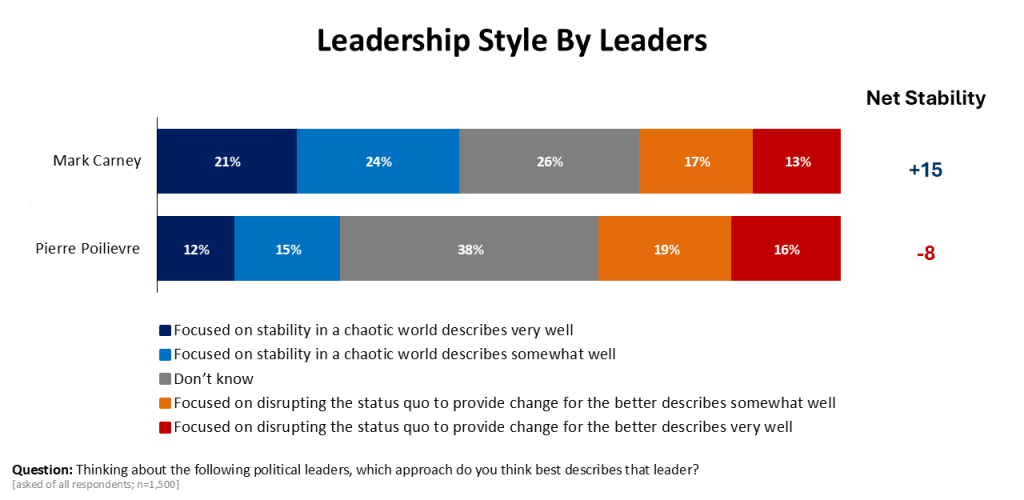
The second part gets more complicated. It turns out a quarter (26%) don’t know whether Carney prefers stability or disruption, while even more (38%) don’t know whether Poilievre prefers stability or disruption. It’s hard for this explanation to carry much weight when people don’t know where the leaders stand.
Among those with perceptions of the leaders’ preferences, a net stability score is used to compare leader perceptions. This score is created by subtracting the percentage who see a leader as preferring disruption from the percentage who value stability.
As expected, Mark Carney’s net stability score sits at +15, with 15 percent more seeing him as valuing stability rather than disruption. Pierre Poilievre’s sits at –8 with 8 percent more seeing him as preferring disruption over stability.
There’s some truth to the pundit’s narrative. But it’s less clear cut than suggested
On the Carney side, 29% of Canadians see him as disruptive rather than stable. And why not? His Davos speech in January did declare the old global trade architecture finished and called out American economic aggression directly.
On the Poilievre side, 27% of Canadians see him as stability-focused, a number that gets lost in the headline score. Many of those people are CPC identifier who prefer stability and see what they want to see in Poilievre. Something that may be easier for them to do now that he has pivoted on his tone.
Pundits are right when they say Canadians want their leaders to provide stability over disruption. And Carney is more likely to be seen as preferring stability, while Poilievre is more likely to be seen as favouring disruption. But a significant minority are not sure where the two leaders stand on these issues. And another large group see the leaders standing for the ‘wrong’ thing, according to the theory.
Leaders need to be careful about this disruption versus stability narrative. But it does not appear to be central to the political landscape we see today.