While Canadians’ views on Indigenous issues remain broadly stable, significant shifts in British Columbia are a signal of possible change.
These results are drawn from an online survey sponsored and conducted by Innovative Research Group between May 21st and June 2nd, 2026. The survey interviewed n=2,031 Canadian citizens, 18 years or older, and the results are weighted to n=1,500 based on Census data from Statistics Canada. Results are weighted by age, gender, region, education, and self-reported federal vote to ensure that the overall sample’s composition reflects that of the actual population according to Census data.
This is the latest in a series of annual surveys on Indigenous issues and attitudes that INNOVATIVE has been running since 2007. In recent years we have seen attitudes toward Indigenous issues at the national level remain consistent, but with several high-profile court cases in British Columbia getting considerable profile, do we see change?
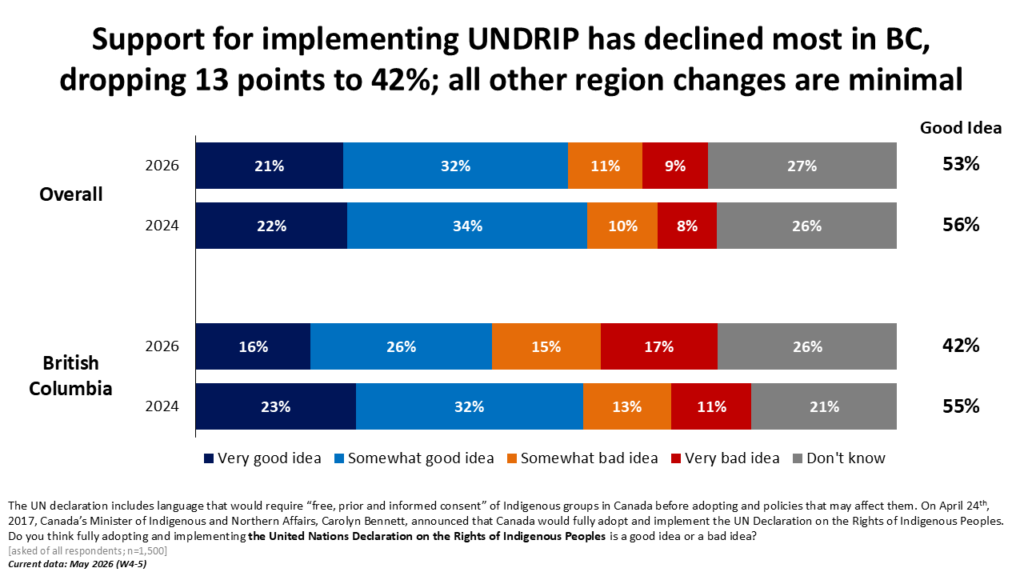
Familiarity with the United Nations Declaration on the Rights of Indigenous Peoples (UNDRIP) currently stands at 23%, consistent with levels observed throughout the tracking period (light blue, below). Support for adopting and implementing UNDRIP has shifted mildly over time, and now stands at 53% (dark blue, below). This is the lowest level we have seen over the past decade of tracking but is only marginally less than 2017 or 2020.
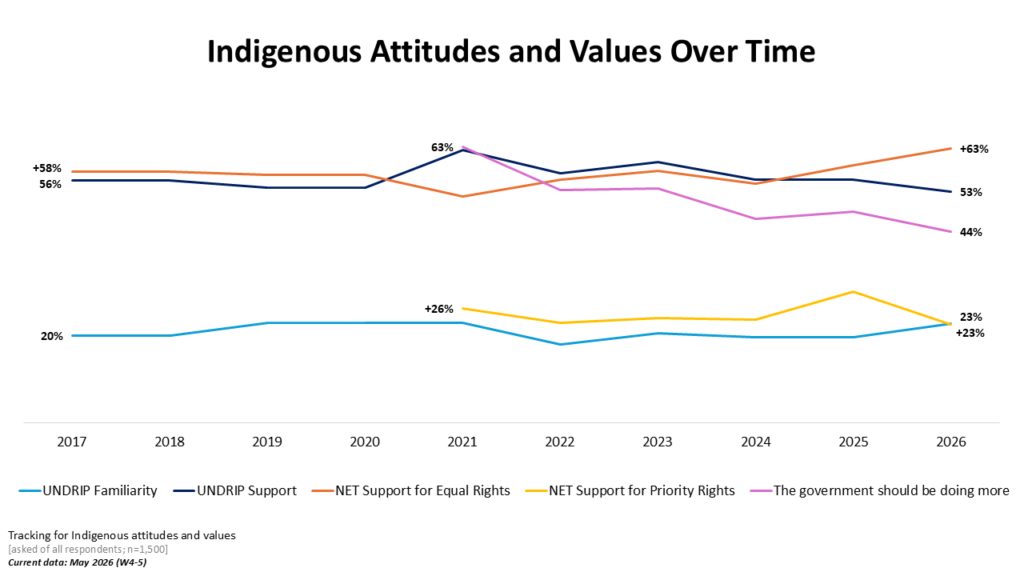
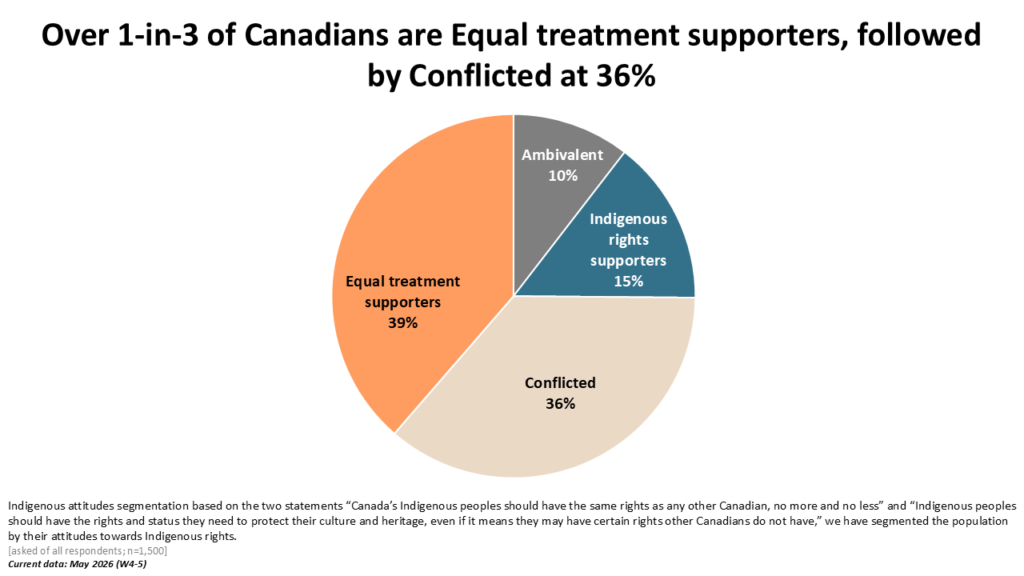
Looking at the broader debate over rights, support for equal rights has increased slightly in recent years (orange, above), while support for priority rights remains largely in line with where it has stood throughout most of the tracking period (yellow, above). However, Equal Treatment Supporters are now the largest segment of the population at 39%, closely followed by the Conflicted at 36%. These Canadians either agree with both perspectives or disagree with both, reflecting a genuine tension in how they think about Indigenous issues. By comparison, just 15% fall into the Indigenous Rights Supporter category. The size of the conflicted middle suggests that future shifts in public opinion are possible, depending on how this group ultimately reconciles competing views about equality and Indigenous rights.
Although national opinion has changed only modestly, British Columbia stands apart. Across multiple measures, this year BC has experienced some of the largest shifts we have recorded. Support for implementing UNDRIP has fallen 13 points since 2024, dropping to 42%. Support for Indigenous peoples having special rights and status to protect their culture and heritage has declined even more sharply, with net agreement falling 18 points to +5 from +23. BC is also the province least likely to say the federal government should be doing more to address Indigenous issues, at 37%. Taken together, these results suggest the conversation around Indigenous rights is changing rapidly in British Columbia.
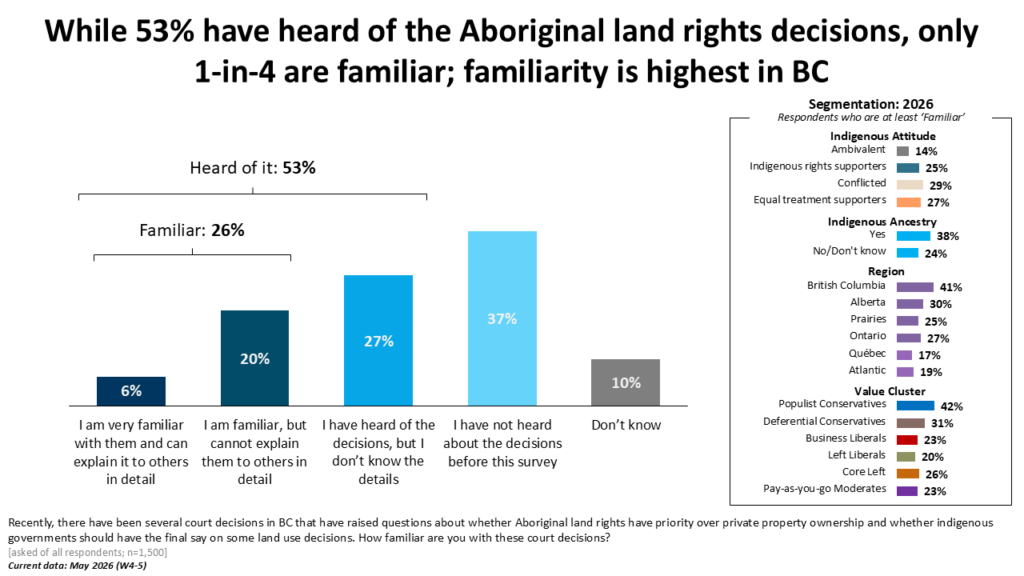
This certainly appears to be related to the high-profile Cowichan and Musqueam cases. We find that 41% of respondents in BC were at least familiar with the court decisions, even if they couldn’t explain them in detail. Nationally that number is 26%. This gap is important, as 59% of respondents nationally are at least somewhat concerned about these decisions, rising to 68% in BC.
 For now, attitudes toward Indigenous peoples remain broadly stable, with little evidence of a major national shift. However, Indigenous issues have become a significant factor in BC politics. There remains considerable support for the idea of UNDRIP. There are also visible tensions around rights and claims, and those are not just a BC thing. While so far most of the impact has been in BC, there are signs that if attention grows, it may have an impact across the country. With that in mind, it seems likely that the opposition, both in BC and Federally, will continue to pursue the issue.
Click here to read the full report!