
Two-thirds of Canadians are following news of the conflict closely, and three quarters say Canada should at least do what it can to expand oil and gas markets.
These results are drawn from an online survey conducted between March 06 and March 16, 2026, sponsored and conducted by Innovative Research Group. The survey interviewed 2,059 Canadian citizens aged 18 and older, with results nationally weighted to n=1,000 by age, gender, region, education, and self‑reported past federal vote to ensure the sample reflects Census population benchmarks.
There has been a buzz in the oil patch over the potential of the war in Iran to accelerate oil and gas development in Canada. We wondered what Canadians were thinking and asked a few questions to see if there is any substance behind the buzz.
Two-in-three Canadians (66%) say they’ve been following the conflict between the United States, Israel, and Iran closely. That’s a higher engagement rate than most domestic policy issues generate, and it cuts across party and regional lines.
What do Canadians think about the conflict?
- 62% expect Canada to become a more attractive source of oil and gas as a result of the conflict
- Among those following it closely, that figure rises to 72%, compared to 47% among those not paying attention
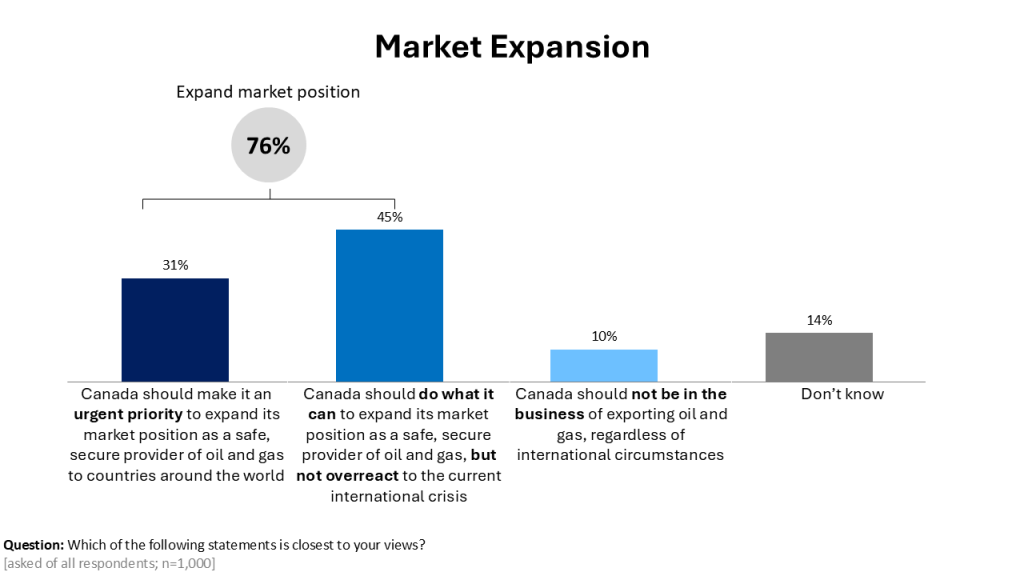
- 76% support expanding Canada’s market position as a safe, secure supplier of oil & gas, including 31% who call it an urgent priority
The broad support number is consistent across regions and all parties. That said, Conservatives are the most passionate advocates, with 45% choosing the “urgent priority” framing compared to 29% of Liberals and 24% of NDP supporters. Liberals and New Democrats cluster instead around a more measured “expand but don’t overreact” position, at 53% each.
There does seem to be something to the buzz. Canadians are clearly open to a discussion about exploring an expansion of oil and gas development. Of course, this was just a few questions dipping to see what way the winds of public debate are blowing. There are counterarguments from oil and gas skeptics and opponents that could find some support. But we also see that support for growing the sector is higher among those paying more attention. If the war and the energy impacts are prolonged, that suggests support could grow stronger.
It is also important to note that a 22% “don’t know” share on the conflict’s long-term supply impact is not trivial. A significant portion of the public simply hasn’t formed an opinion yet.
Overall, this shows a surprising degree of attention from Canadians to the war and potential support for oil and gas expansion. As the energy implications of the war become clearer, INNOVATIVE will dig deeper into this issue.