
Since the election, both the Liberals and CPC have lost over 10-points in approval on how they are responding to Donald Trump. While we see a similar decline in the number of Canadians willing to choose either Carney or Poilievre as better on handling Canada/US relation, Carney continues to enjoy a double digit lead over Poilievre.
These are the results of an online survey conducted between January 02 and January 13, 2026, sponsored and conducted by INNOVATIVE RESEARCH GROUP. This survey interviewed n=2,249 Canadian citizens, 18 years or older. The results are nationally weighted to n=1,500. Results are weighted by age, gender, region, education, and self-reported federal past vote to ensure that the overall sample’s composition reflects that of the actual population according to Census data.
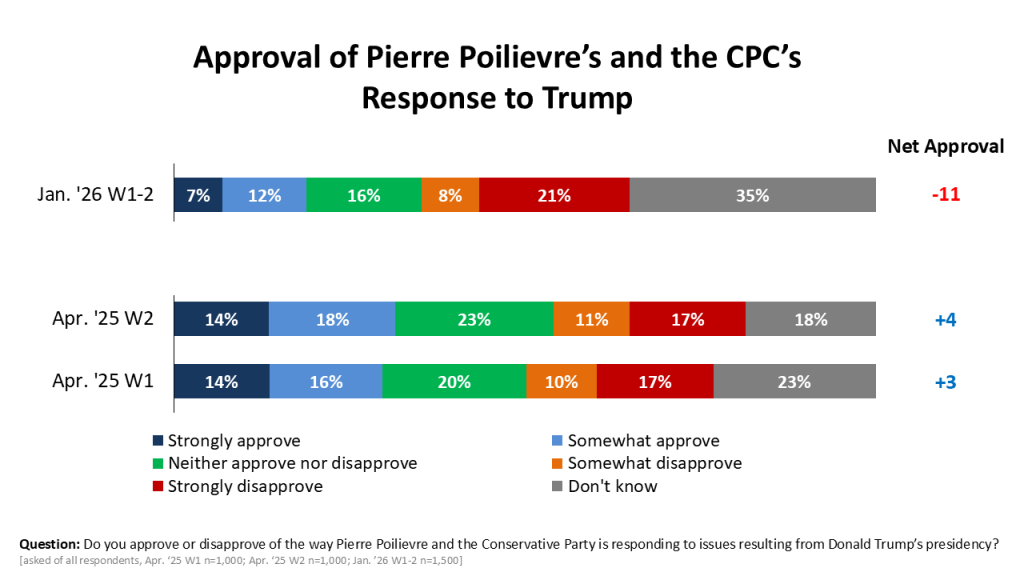
Poilievre’s Net Approval on Trump Turns Negative
Growing uncertainty about Pierre Poilievre’s and the Conservative Party’s approach to Canada–U.S. relations has pushed their net approval on dealing with Trump into negative territory, now at -11 points. This helps explain why, despite some post-election softening in perceptions of his leadership, Mark Carney retains a substantial advantage over Pierre Poilievre on this file, leading by 17 points.
Federal Government Approval on Trump Softens
Since the election, approval of the federal government’s handling of issues related to Donald Trump has declined by more than 10 points, with net approval now at +11, down sharply from spring highs. Notably, this softening has been driven less by a surge in outright opposition and more by growing uncertainty, as more Canadians move into “don’t know” responses rather than decisively turning against the government’s approach. Older Canadians remain the most supportive of the federal government’s handling of Trump, while younger voters are more skeptical, reflecting a broader generational divide. Open-ended responses suggest that even among those who approve, support is often conditional, rooted in perceptions that the government is standing up to Trump, while among critics, the dominant concern is that Ottawa is not being tough enough, reinforcing a picture of softening confidence rather than rejection.
Best Leader on Managing Canada–U.S. Relations
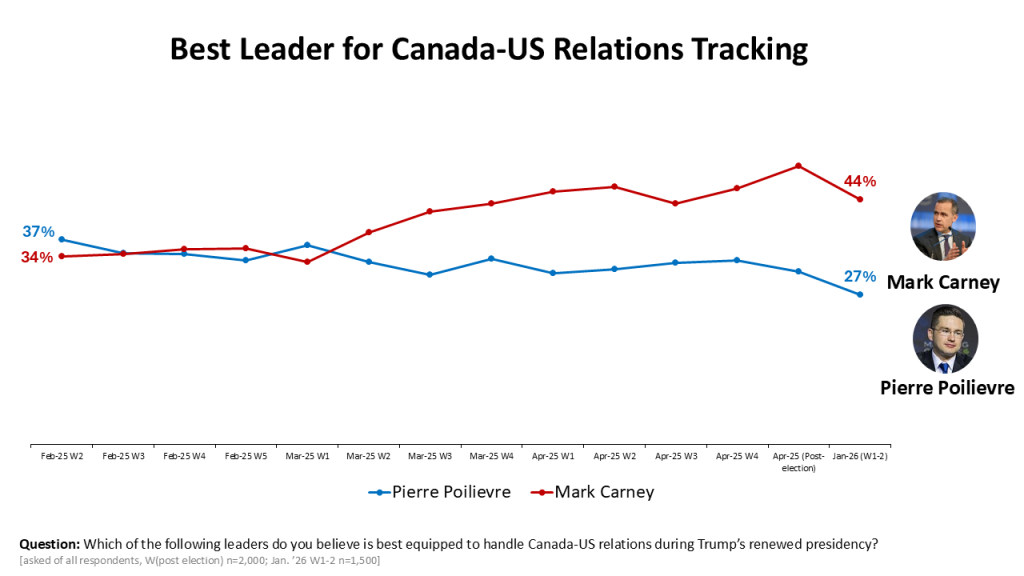
Since the election, fewer Canadians view either Mark Carney or Pierre Poilievre as the best leader to manage Canada–U.S. relations, signalling growing uncertainty about both major party leaders on the Trump file and creating openings for the NDP and Bloc.
Within this softer environment, Carney maintains a clear 17-point advantage over Poilievre (44% vs. 27%), performing strongest among voters who are conflicted or afraid about Trump’s presidency, while Poilievre continues to struggle to expand beyond his core base. While Carney remains ahead, the shrinking pool of voters suggests his advantage is somewhat fragile.
Different Stances Toward the U.S. Show Different Voter Profiles
Our results show that Liberal support is stronger not among Hawks or Doves, but among those who are conflicted, torn between retaliation and restraint. Canadians who are disengaged on the issue of Canada–U.S. relations (“Uncommitted”) are most likely to back the Conservatives. This suggests that Conservative support is stronger among voters who are either skeptical of the debate altogether or unconvinced by existing policy options, rather than among those with strong views on managing the Canada–U.S. trade relationship. Finally, voters who favour a firmly hawkish approach are the most likely to support the NDP. Doves are split between the Liberals and the Conservatives.
Affordability Reasserts Itself as the Defining Issue
While performance in dealing with Trump still matters, it matters less than it did immediately after the election. Since then, the share of voters who say responding to Trump is their top priority has fallen from 19% to 13%. By contrast, affordability has continued to consolidate its dominance, now cited by 41% of voters as their top issue (up from 38%). Notably, younger Canadians are far more likely than older voters to rank affordability first.
Issue priorities are closely linked to vote intentions. Those who prioritize affordability are significantly more likely to support the Conservatives, while voters focused on responding to Trump lean Liberal.
A Tight Race Masks a Sharp Age Divide
Even as affordability has risen to the top of voters’ concerns, the race has remained remarkably stable, with the Liberals narrowly ahead of the Conservatives (41% vs. 39%). But this overall competitiveness conceals a stark generational split. Conservatives hold a decisive edge among middle-aged voters (44% vs. 35%), while Liberals dominate among seniors (47% vs. 35%). Younger Canadians, meanwhile, remain a true battleground: support is almost evenly split (38% Liberal, 37% Conservative). It is important to note that Liberal support among younger Canadians surged at the end of the last election, coming mostly from NDP and Bloc voters. If that happens again, the Liberals would grow their lead over the CPC and would have a good chance at a majority.
The Bottom Line
Net approval of Pierre Poilievre’s response to Trump has now slipped into negative territory, reflecting growing uncertainty about his approach. This helps explain why Mark Carney continues to hold a clear advantage over Poilievre in managing Canada-US relations, even as approval of the federal government’s performance on this file has softened. Approval remains positive but increasingly fragile, with support resting mostly on persuadable voters conflicted between a dovish and a hawkish approach. Moreover, with affordability now reasserting itself as voters’ dominant concern, the political payoff of leadership on the U.S. file is narrowing.