
Canadians are much less likely to hold aggressive views on how to respond to Donald Trump now compared to last spring when tensions were rising. Agreement with more cautious approaches remains more stable, providing governments with more flexibility on how to manage their response to Trump tariffs and other provocations.
These are the results of an online survey conducted between January 02 and January 13, 2026, sponsored and conducted by INNOVATIVE RESEARCH GROUP. This survey interviewed n=2,249 Canadian citizens, 18 years or older. The results are nationally weighted to n=1,500. Results are weighted by age, gender, region, education, and self-reported federal past vote to ensure that the overall sample’s composition reflects that of the actual population according to Census data.
Emotional Reactions: Cooling but Still Aggrieved
While a majority of Canadians continue to report feeling angry (58%) and betrayed (52%) by Trump’s treatment of Canada, intensity on both emotions has declined since last spring. Despite the fact this survey was in field during a time of intense US international provocation, the slide in intensity we first noted in the summer continues this January. Frequently feeling betrayed is down 12 points since last spring while frequently feeling angry is down 9 points. Other emotions are not shifting. There is no increase in fear or hope. It just seems some Canadians cannot sustain the white-hot anger of Trump’s early days.
Taking the Longer View in Responding to Trump
In January of 2025 when we first started exploring Canadians’ views on how government should respond to Trump, we found Canadians were conflicted and just as likely to agree with ‘hot’ response such as banning the export of critical products to the US as with ‘cooler’ responses such as Canada should be patient and Canada should be careful not to take actions that could hurt our relationship. Over the lead-up to the federal election, support grew for the ‘hotter’ options and held or even declined for the ‘cooler’ options.
What a difference a year makes.
The number of Canadians who support banning the export of critical products to the US has dropped from 61% last march to 52% today. All the decline is in intensity: strong support has dropped from 33% to 21%.
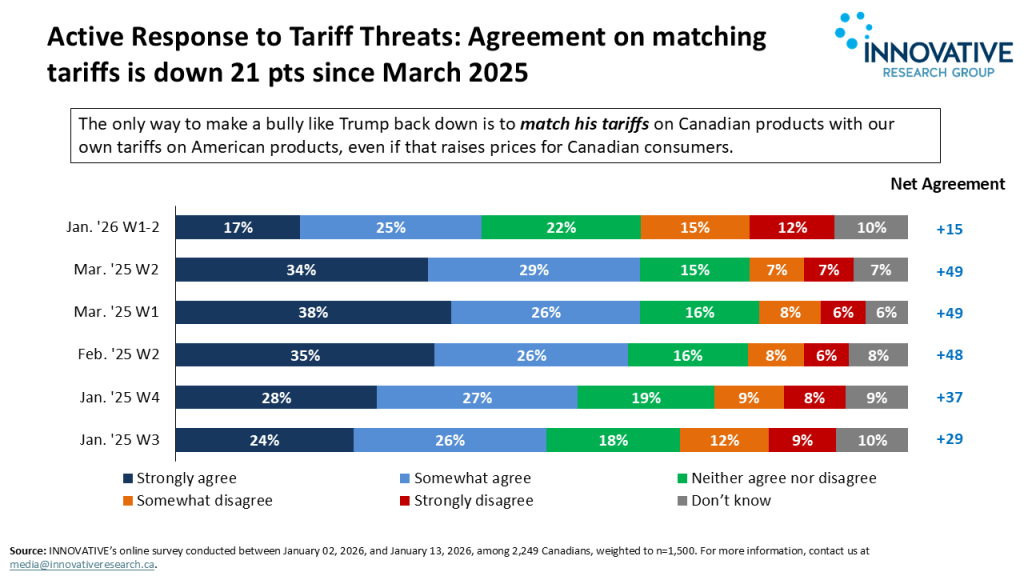
The decline is even steeper on agreement with the statement that “the only way to make a bully like Trump back down is to match his tariffs on Canadian products with our own tariffs on American products …” Agreement is down 21 percentage points, from 63% in March to 42% today.
Canadians are more Dovish than Hawkish
Looking across opinions on different trade policy approaches toward the United States, we see four distinct groups. Hawks (18%)—who favour economic retaliation with tariffs, escalation if necessary with bans, and reduced reliance on the US—are the smallest group. Canadians are more likely to be Doves (27%), preferring a long-term strategy that avoids escalation, protects key US ties, while reducing reliance on the US The remainder are either Uncommitted (23%), expressing little support for any policy option, or Conflicted (31%), endorsing elements of both hawkish and dovish approaches.
More Flexibility For Government
As the New Year begins, governments find Canadians’ emotions toward Trump are easing. This is matched by a decline in desire for ‘hot’ policy responses to Trump aggressions and more openness to more pragmatic approaches allowing internal American opposition to have an impact.
What has NOT changed is Canadian’s commitment to diversification. Agreement that “Donald Trump’s tariff threat has highlighted the need for Canada to increase the amount we export overseas and to reduce our economic dependence on the US” remain strong and stable. Three-quarters (75%) of Canadians agree with that statement today, exactly the same as the number in March.
In sum, the public seems increasingly aligned with the Carney approach in government rather than the elbows up approach from the campaign.