
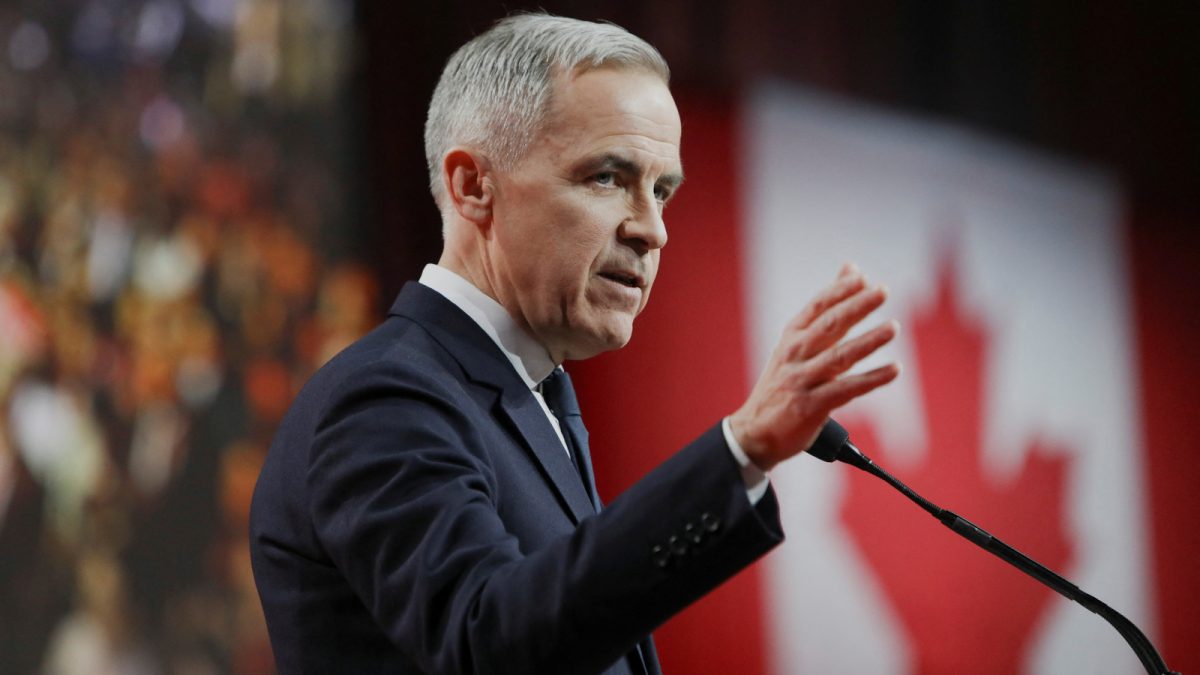
Former Bank of Canada and Bank of England governor Mark Carney speaks after he won the race to become leader of Canada's ruling Liberal Party and will succeed Justin Trudeau as Prime Minister, in Ottawa, Ontario, Canada, March 9, 2025. REUTERS/Amber Bracken/Pool TPX IMAGES OF THE DAY
A deeper dive on the MOU between Ottawa and Alberta shows that Alberta UCP voters and BC NDP voters are more likely to think it is mostly good than mostly bad.
These are the results of an online survey conducted between November 27th, 2025 and December 1st, 2025, sponsored by INNOVATIVE. This survey interviewed n=1,846 Canadian citizens, 18 years or older. Because of regional oversamples, the results are nationally weighted to n=1,250. Results are weighted by age, gender, region, education, and self-reported federal past vote to ensure that the overall sample’s composition reflects that of the actual population according to Census data.
Last week we posted to discuss the relatively low awareness the MOU had generated among average Canadians. This week we are digging deeper:
- Reviewing the open-ended responses for why Canadians support or oppose the MOU
- Exploring the reactions in the two most impacted provinces, Alberta and British Columbia.
Let’s start with a quick refresher. Last week we reported the initial reaction without any background was 42% mostly good to 13% mostly bad. The survey then provided a summary based on the federal government release and then asked for an “aided” reaction. This response was a little less favourable (36% mostly good, 13% mostly bad), with the difference among people who are not familiar saying the agreement is a mix of good and bad. See the full release here.
When looking at open-ended responses we see that the economic signal comes through strongly among those with a positive first impression of the MOU. Economic benefits (20%) and economic diversification (18%) make up two of the top three responses:
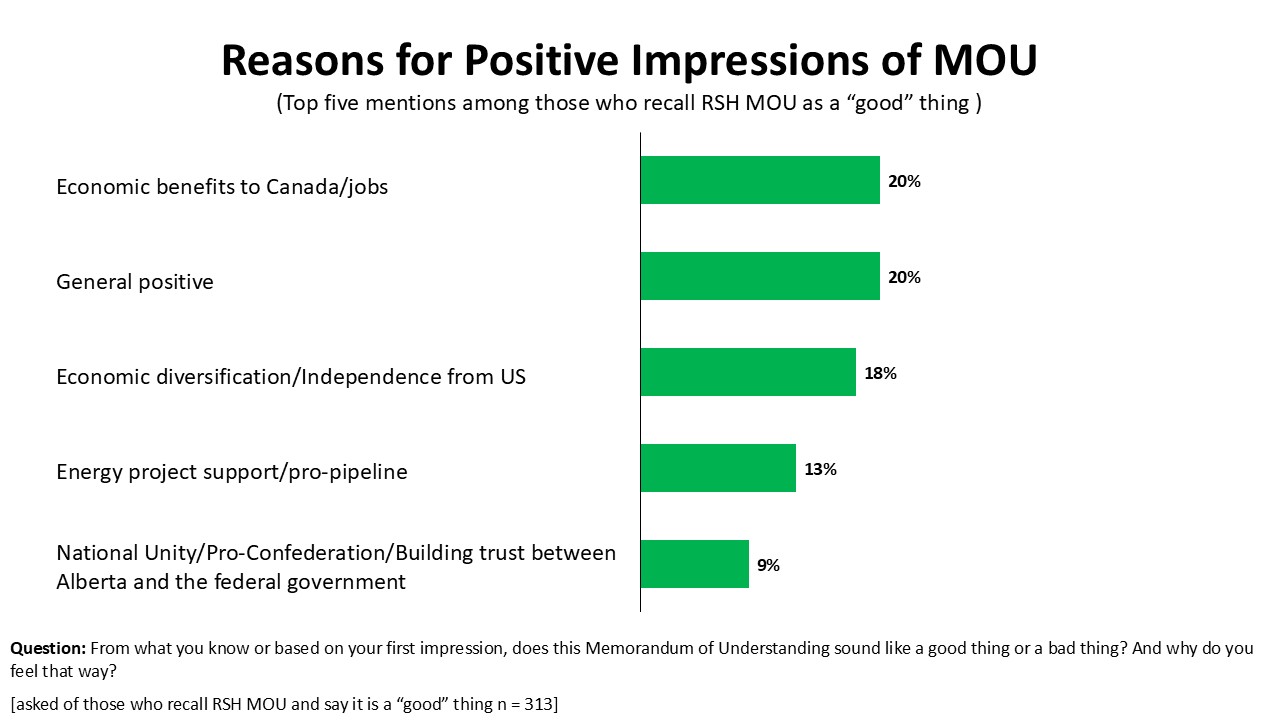
Looking at underlying beliefs, the economic argument and building mutual trust, forms the core support narrative for the MOU. More than six-in-ten Canadians (63%) agree the MOU strengthens the economy and reduces our dependence on the United States, with support exceeding 70% among Populist Conservatives, Differential Conservatives, and Business Liberals.
Among the negative reactions to the MOU far and away the most common answer is environmental concerns (35%), followed by lack of BC consultation/BC opposition (13%). Lack of consultation with indigenous groups gets only a handful of responses, despite the substantial support for indigenous consultation, indicating this isn’t a top of mind issue for most.
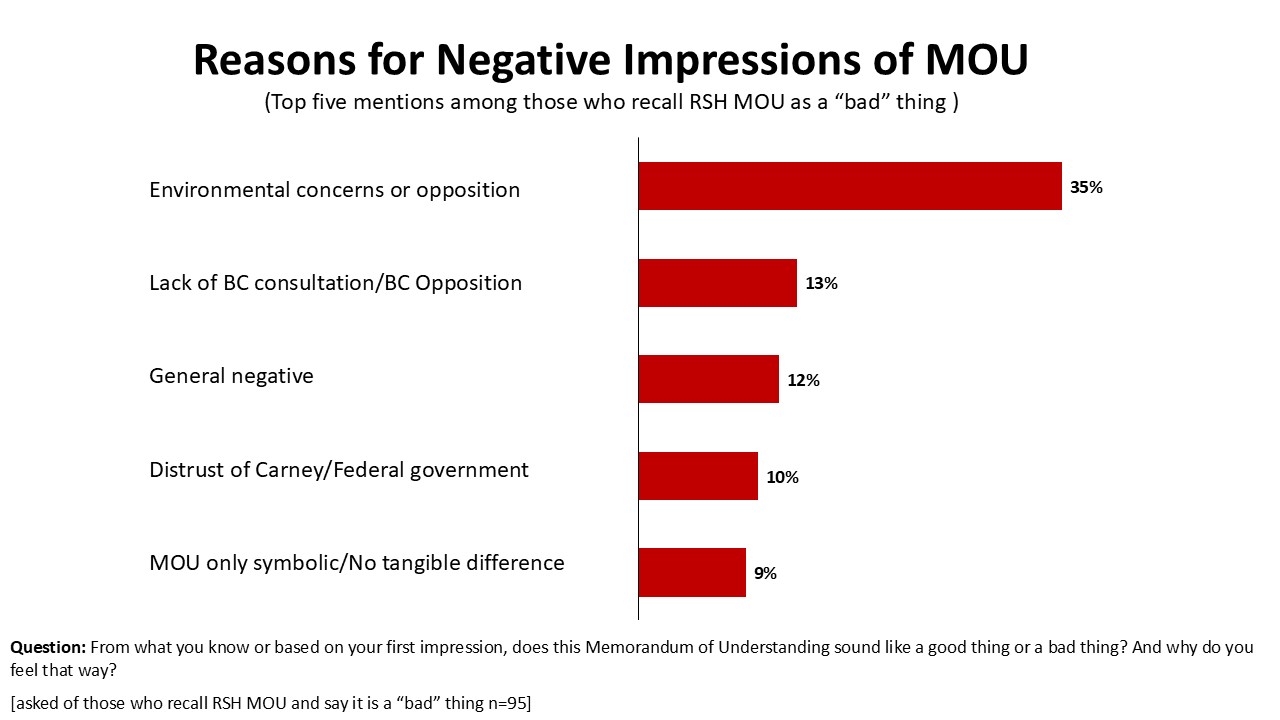
Looking at underlying beliefs, climate commitments and interprovincial fairness form the core resistance narrative. Nearly four-in-ten (39%) believe the MOU sacrifices climate commitments, a view that rises sharply among NDP (57%), Bloc (57%), and Core Left (50%) segments, while majorities also object to BC (55%) and Indigenous groups (52%) being excluded. Indigenous consultation concerns are much stronger in response to the agree/disagree statement then it first appears in the open-ended.
Turning to the two key battleground provinces, when asked the initial reaction question the MOU saw positive responses from a majority among Albertans (55%) but only a plurality of British Columbians (39%).
More important than that topline, however, is the partisan breakdown on the aided impression. This gives us a look at how political leaders in the two provinces will have to manage their actual voter coalitions. In British Columbia, Premier Eby sees a close balance between ‘good’ (33%) and ‘bad’ (26%) on the aided impression among self-identified NDP supporters. Another 33% say a mix of good and bad. Among those in BC who do not identify as an NDP voter, positive impressions are about the same, but negative attitudes to the MOU are lower.
In Alberta, where Premier Smith is trying to manage a fractious party and a separatist movement, the MOU is seen as at least ‘mostly good’ by 48% of UCP voters, with only 15% saying at least ‘mostly bad’. This probably provides some political benefit. Among non-UCP voters the positives are lower (34%), but so are the negatives (7%), with the most common response being a ‘mix of good and bad’ (45%).
Looking at the country as a whole, we see a clear divide in reactions based on political inclination, with those on the political right being reliably more positive than those on the political left. Quebec and Alberta are provincial poles, driven by differing environmental attitudes. British Columbia, however, is more nuanced. Premier Eby seems to have more room to maneuver with his NDP voters than many might have expected. Premier Smith also appears to have an opportunity for some of the political cover she hoped for.
All that said, many Canadians remain uncertain and many first impressions are lightly held. There is a lot of potential for these numbers to change.
Click here to read the full report!